
Training should be Fun and Affordable.
Let's make training fun. Hook up a projector and a webcam, and watch your space become your own simulator. OpenHockey Engine watches the puck, finds the exact point of contact, and calls the shot - in Free Shoot, in nine arcade games, or in a four-golfer round of Golf.
- No spendy subscriptions
- No in-game purchases
- Just a one-time purchase of $30
- 10 playable game modes
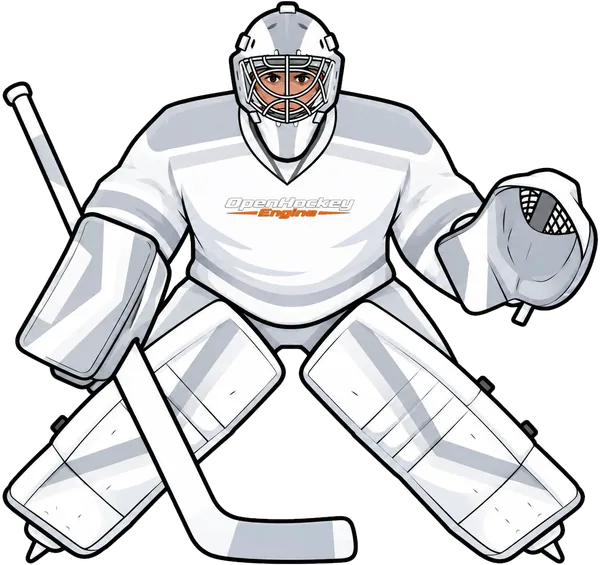
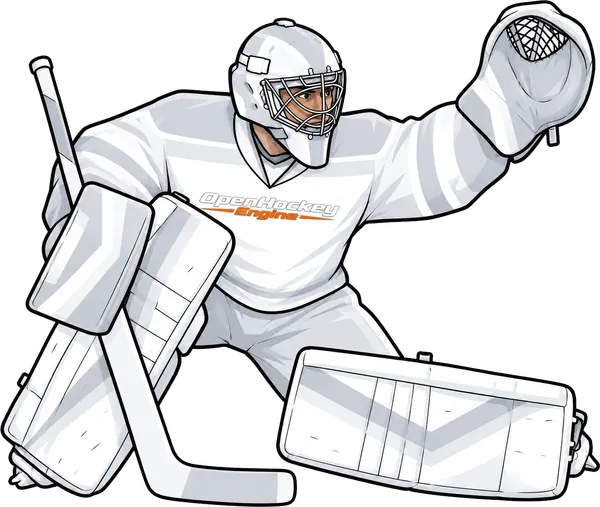
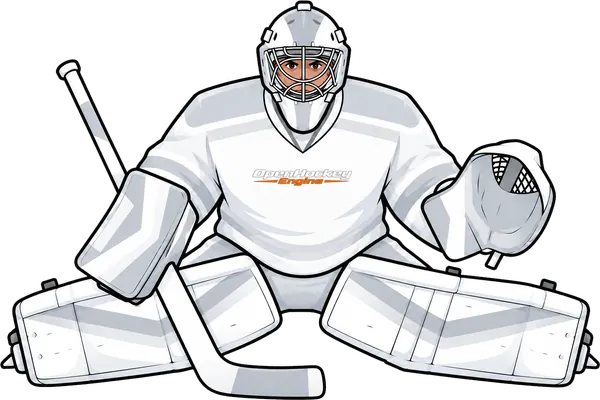
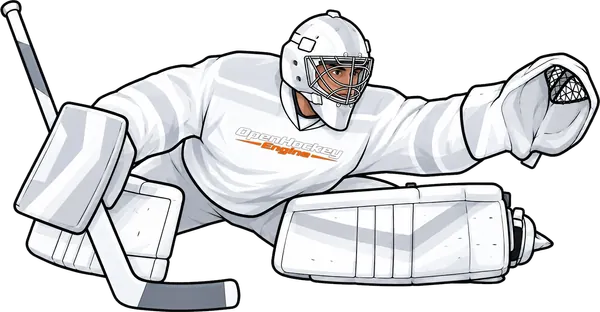
- 5 goalie stances
- $30 one-time purchase
- 30 fps+ live puck tracking
3 steps from empty garage to your own simulator, right at home.
No physics engine guesswork, no controller, no sensor array. A camera watches the projected screen and the game determines where your shot landed on the screen.
Set up your space
Set up your shooting area with a contact-rated projector screen or shooting tarp, netting, and a shooting pad.
Set up your technology
Set up your computer and projector outside the shooting area. Point a webcam at the projected playing surface, then calibrate once: the game measures the projected area and you fit a box around it so it knows exactly where your shot hit.
Take the shot
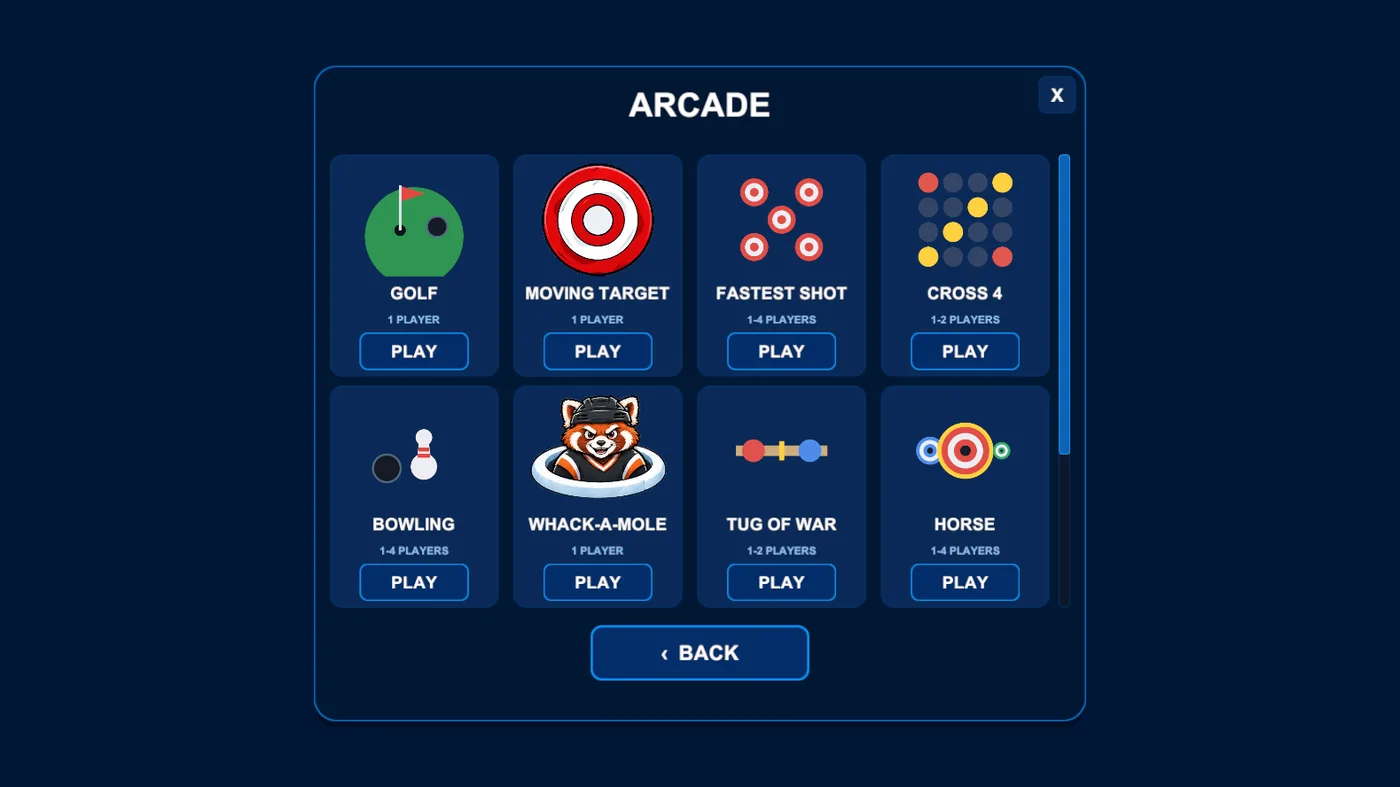
Play Free Shoot to pick an angle and a goalie, use the coaching timer, and dial in your accuracy. Or jump into the arcade for Golf, Moving Target, Fastest Shot, Cross 4, Bowling, Whack-a-Mole, Tug of War, Horse, and Darts.
This Is Your Game. Train Your Way.
10 playable modes: Free Shoot for focused practice, and 9 arcade games when you want a score, a clock, and a reason to take the next shot - including Golf for one to four golfers on the same projector.
Free Shoot
IncludedChoose Your Angle. Choose Your Goalie. Take Your Shot.
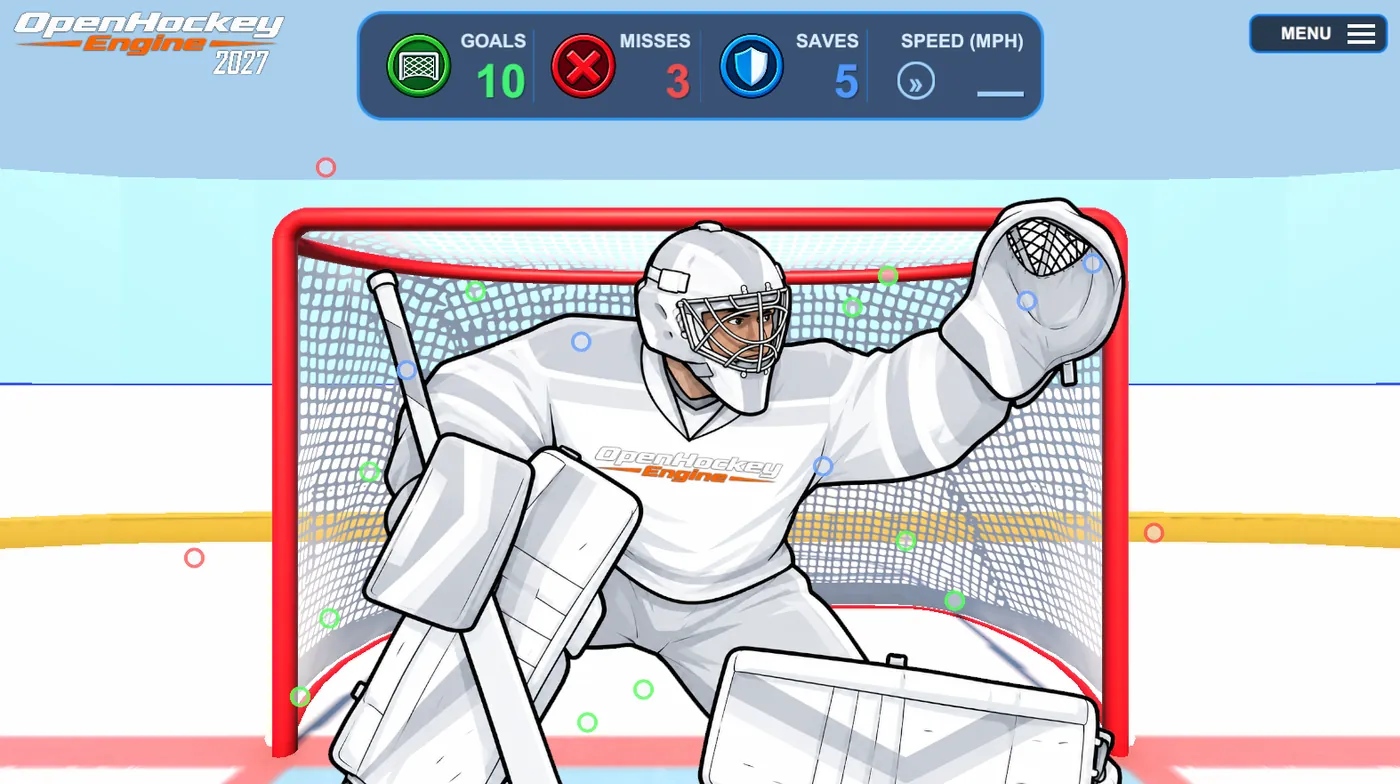
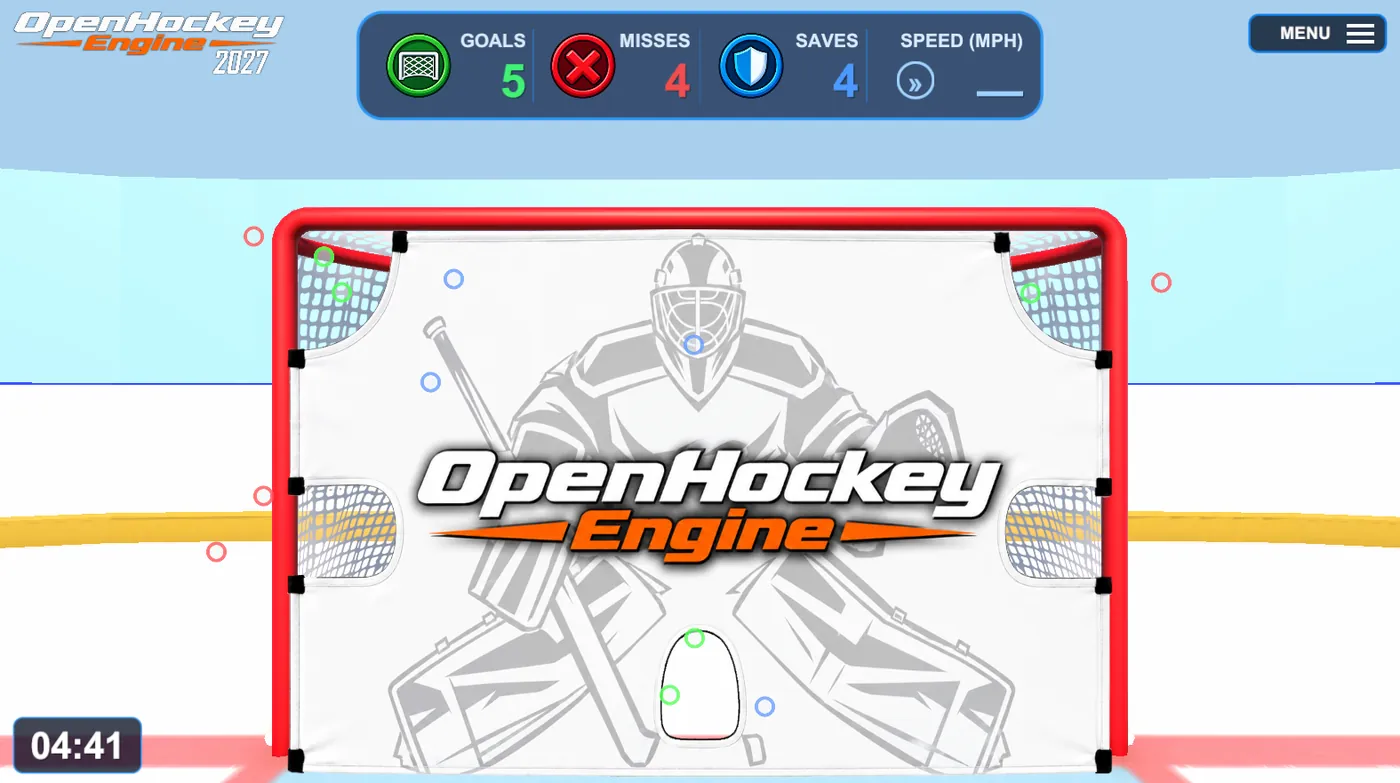
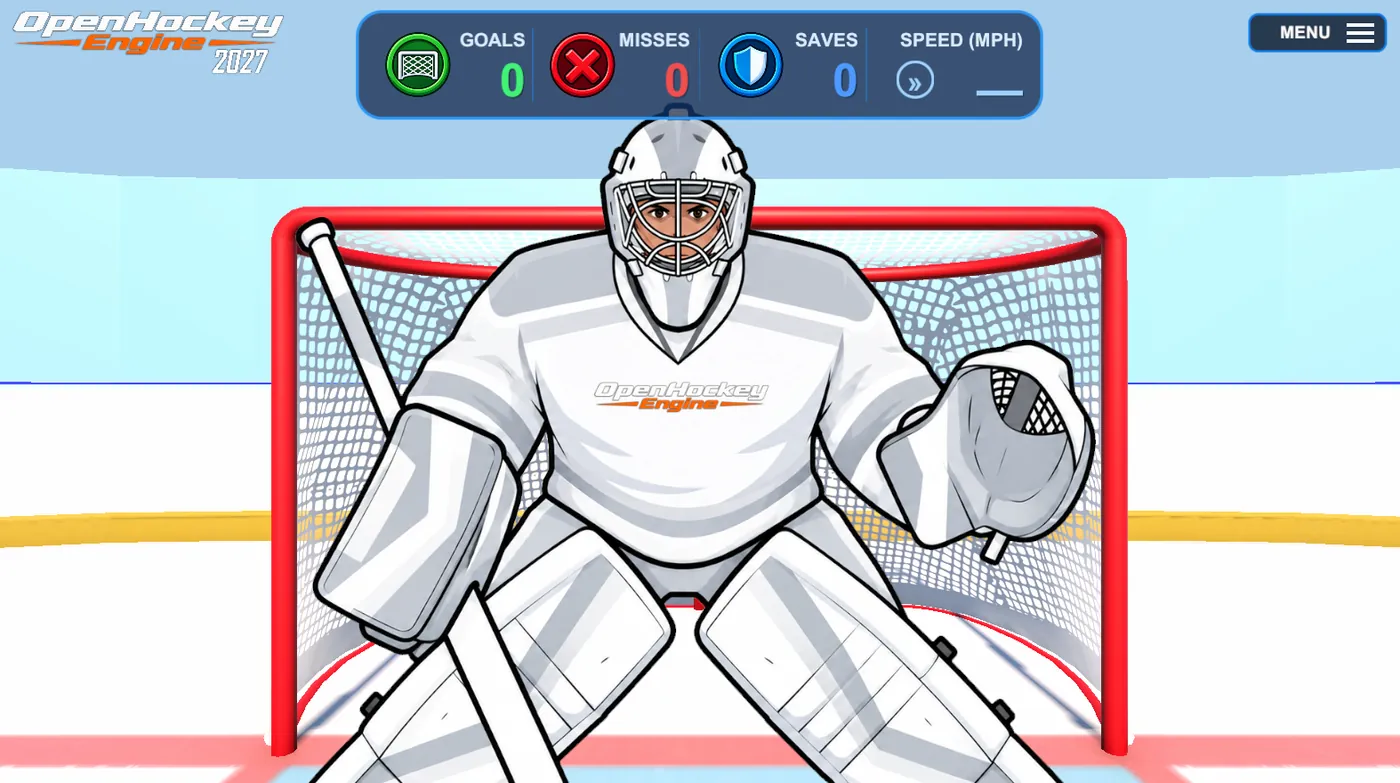
The sandbox. A goalie steps into the crease and holds the net. You take the shot, the camera finds exactly where the puck made contact, and the game calls it - goal, save, or miss - judged frame by frame against the net.
- Five shooting angles: Center, Left, Right, Goal Line Left, and Goal Line Right.
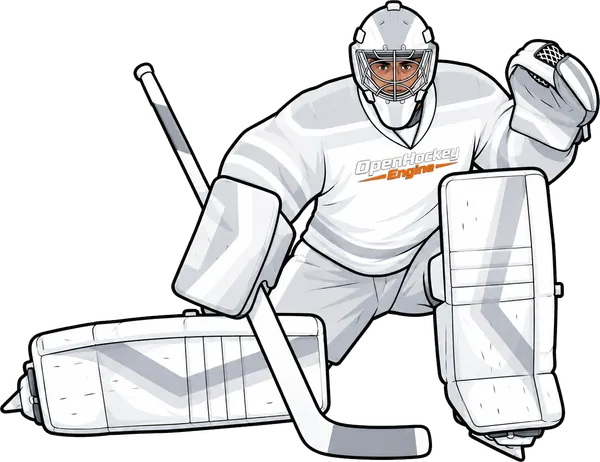
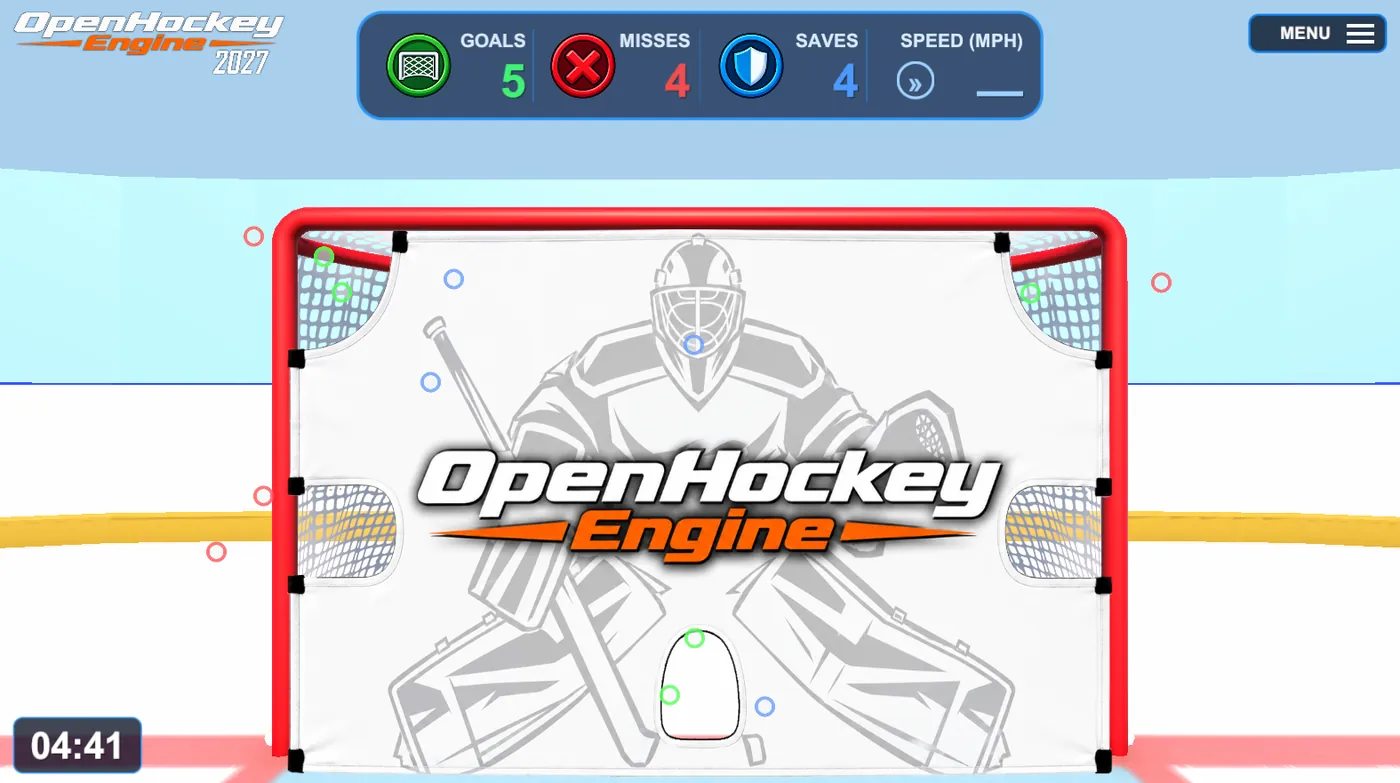
- Standing, high glove, butterfly, desperation, tight to the post, the Shooter Tutor, or an empty net.
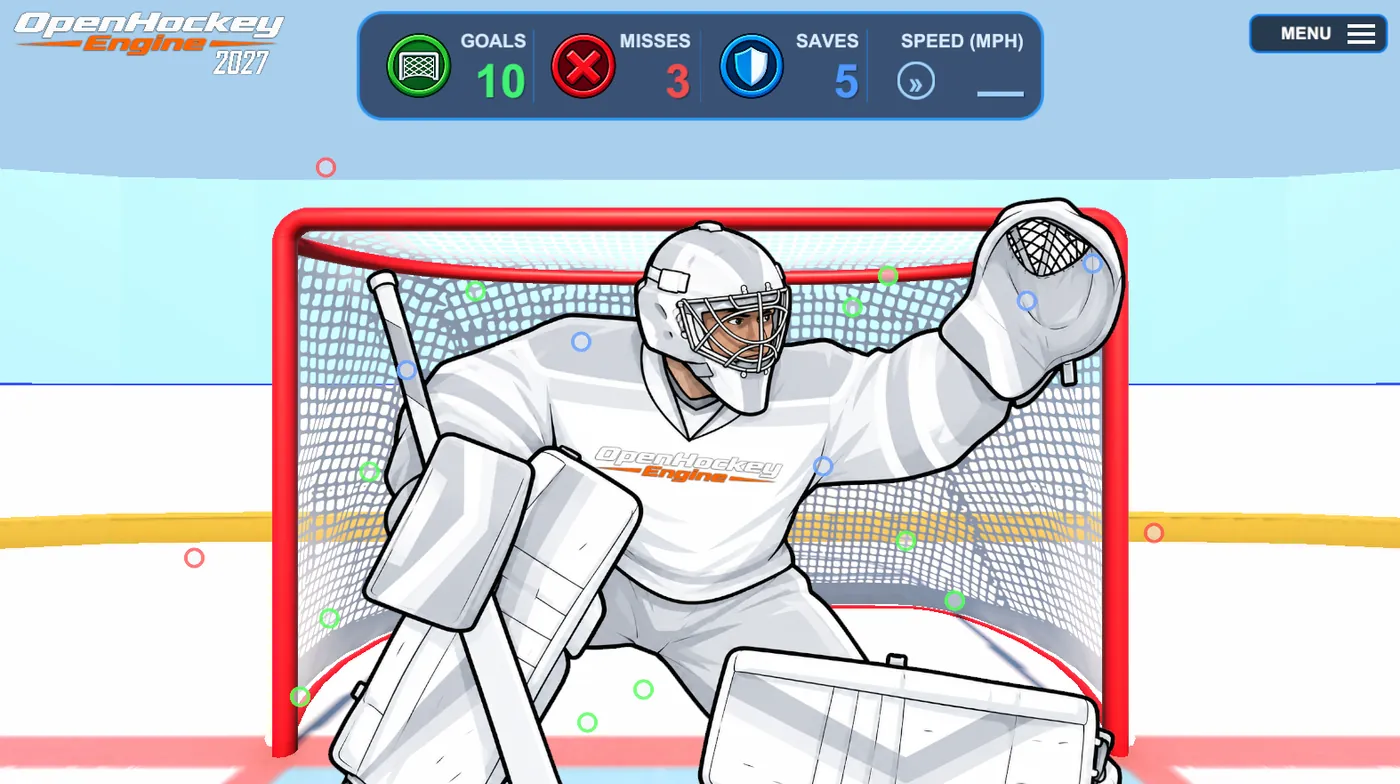
- Goals, misses, and saves counted live, with every shot marked where it landed.
- Puck speed in MPH on every camera shot.
- Per-goalie size, position, and flip controls, with goalies fitted to the net at every angle.
- Coaching timer and the Lifting the Puck drill at three difficulties, plus a reset for the session stats and markers.
Golf
IncludedFour courses. Up to four golfers. Fewest strokes wins.
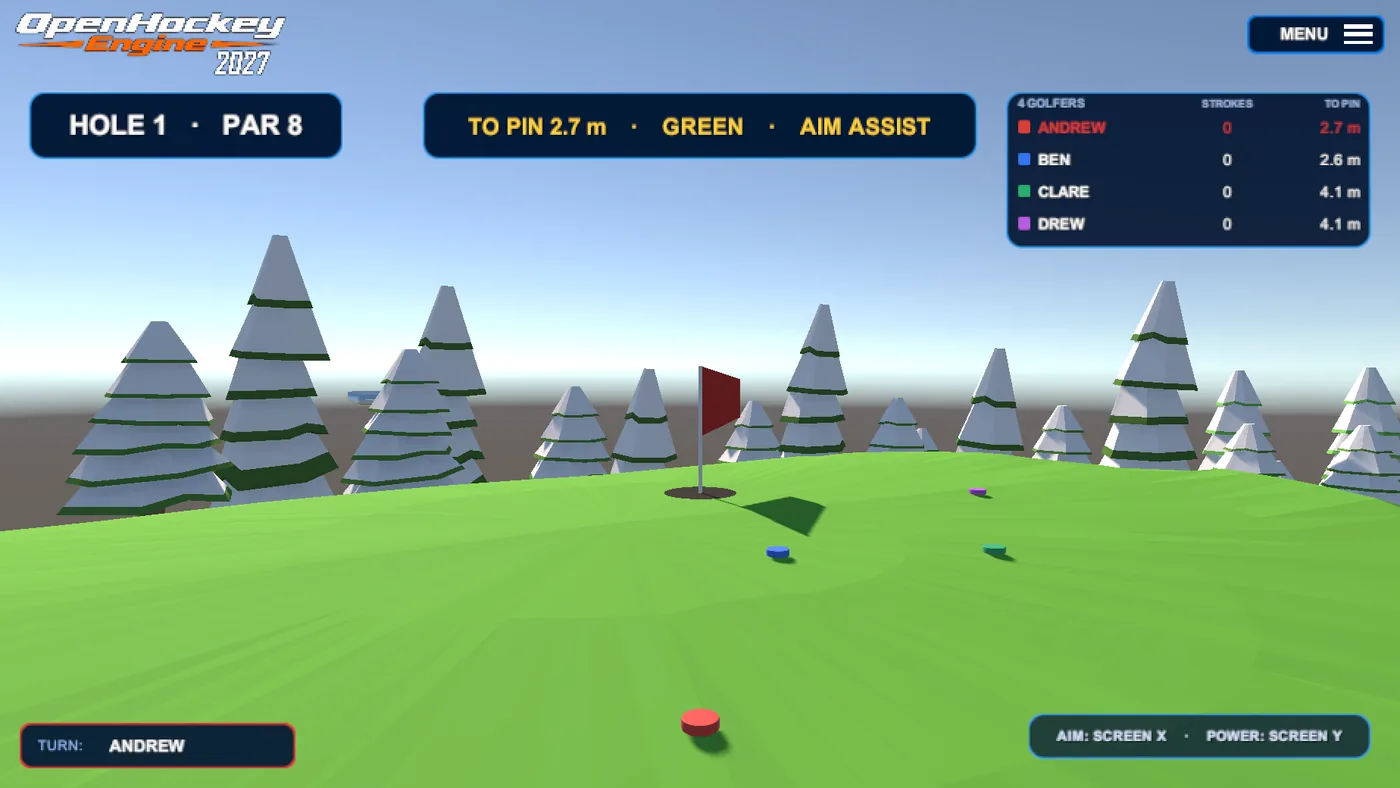
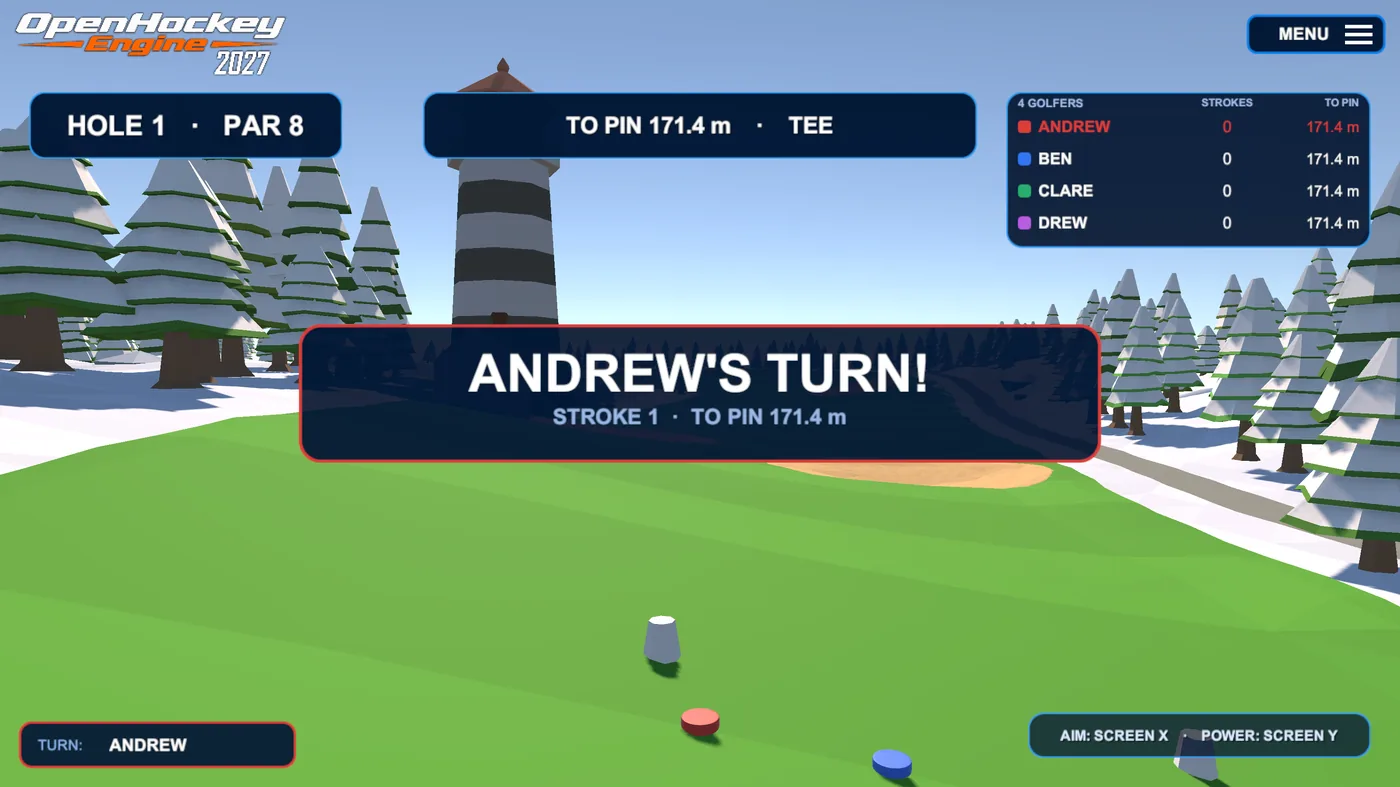
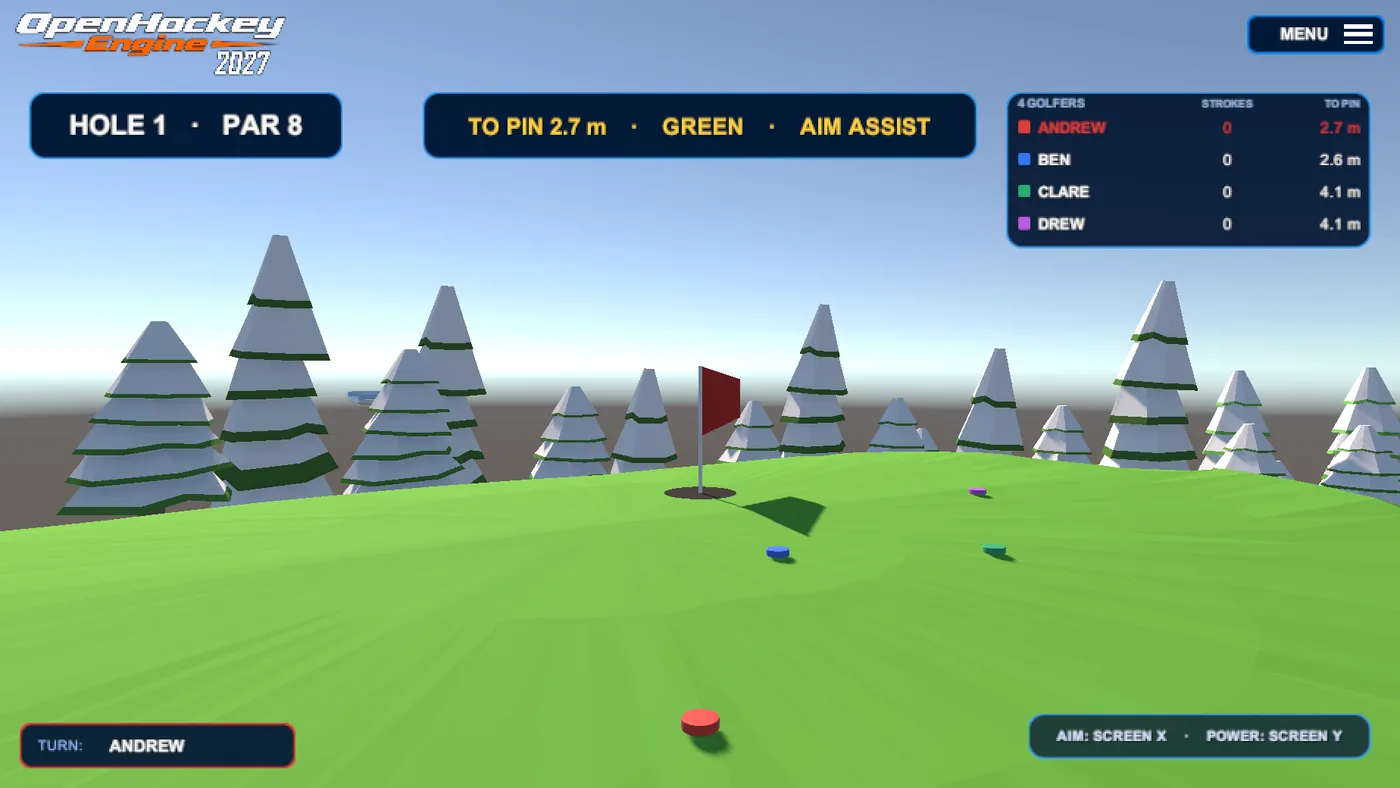
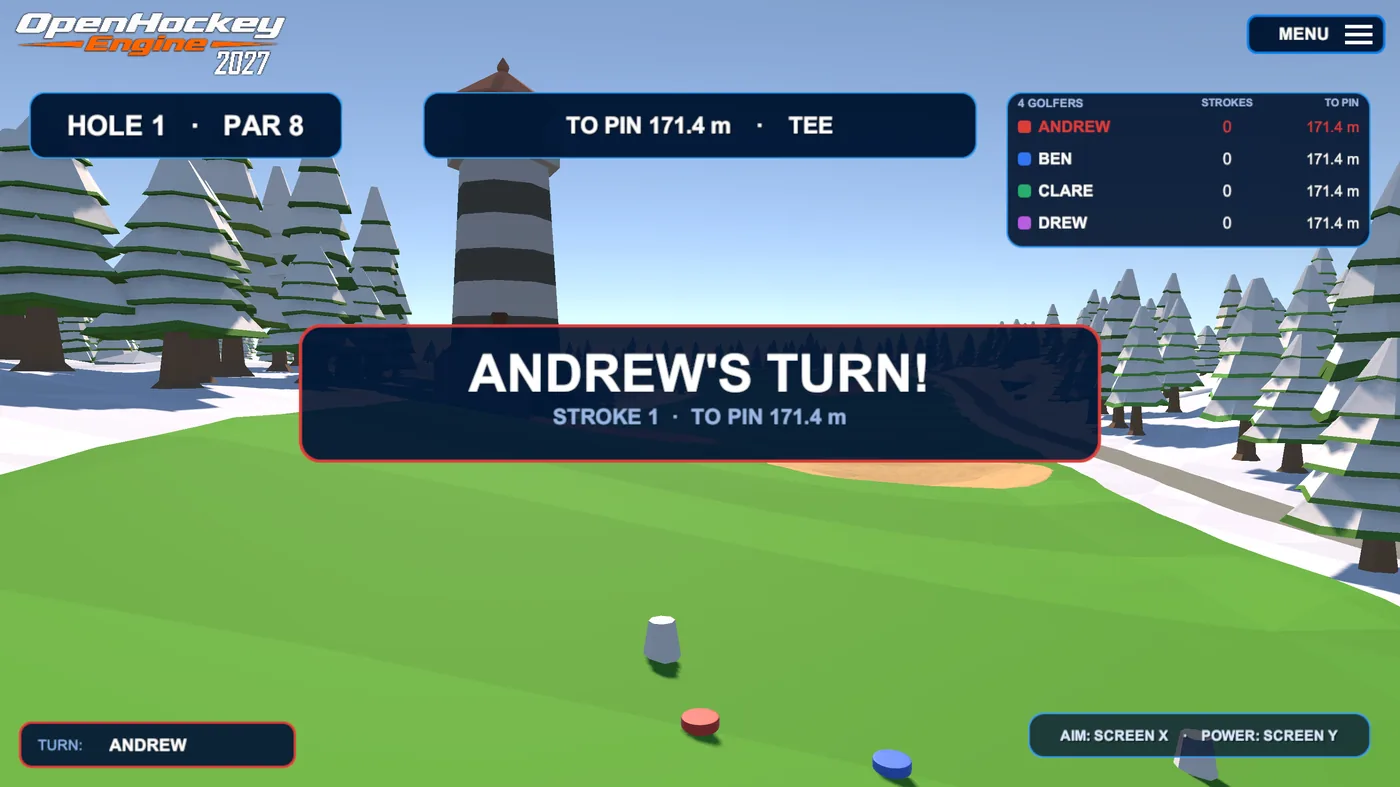
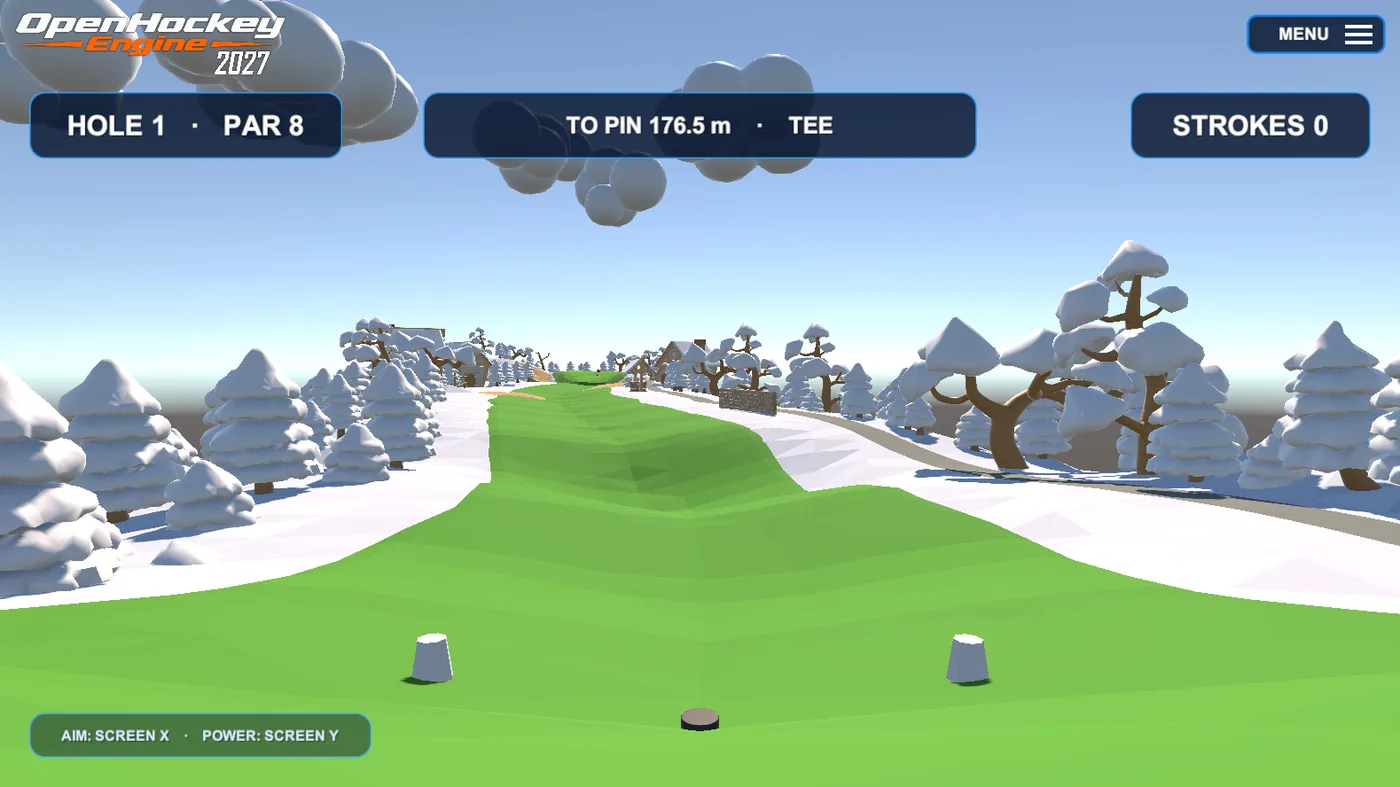
A real golf hole, played with pucks. Your shot's screen position IS the shot: left and right aim it, high and low set its distance. Play the lie you get - the rough takes half your power, sand takes three quarters, and water costs a stroke - then chip onto the green and sink the putt. Play alone, or seat up to four golfers on one projector: every golfer gets a coloured puck and a roster row showing their strokes and how far they still are from the hole, and the golfer furthest from the pin plays next. One hole per round, stroke play, and the lowest score holds the board.
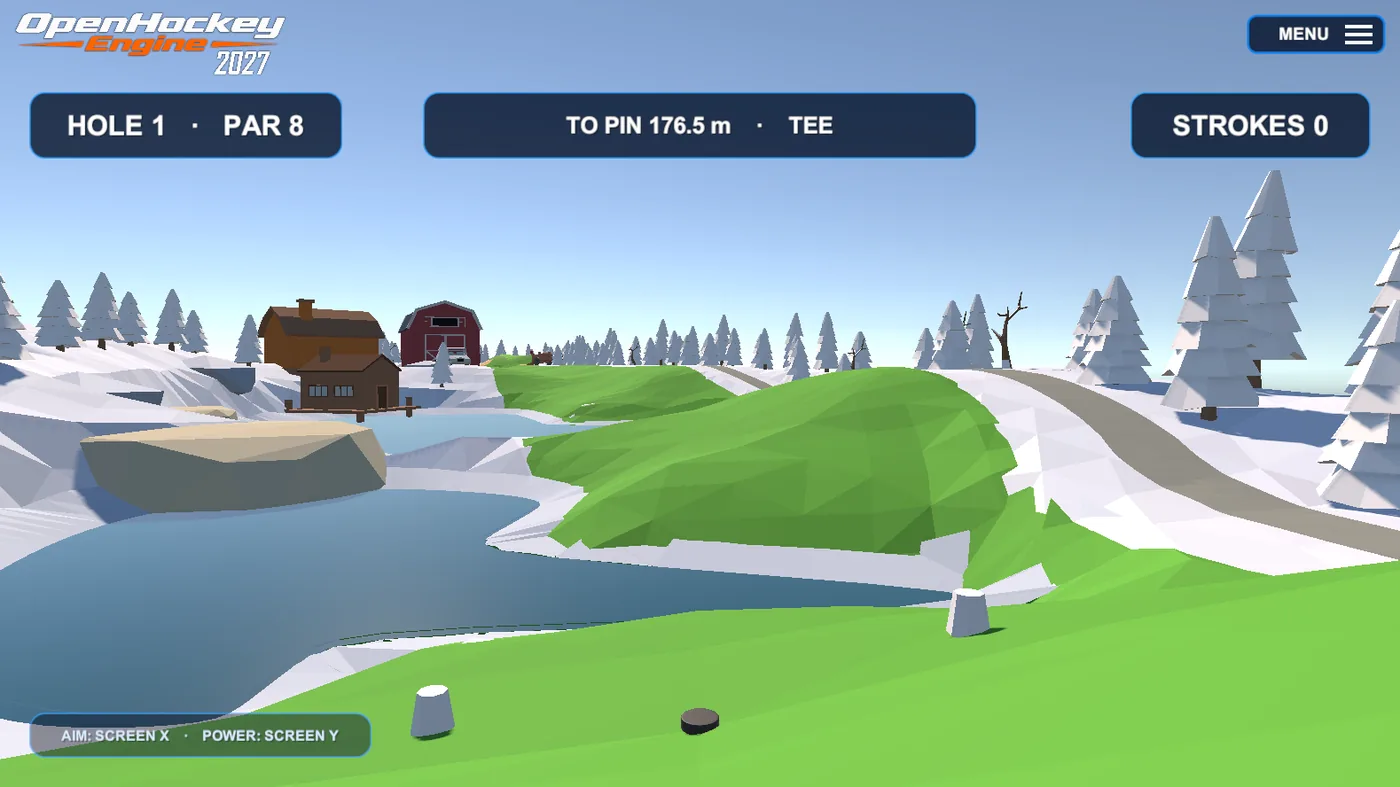
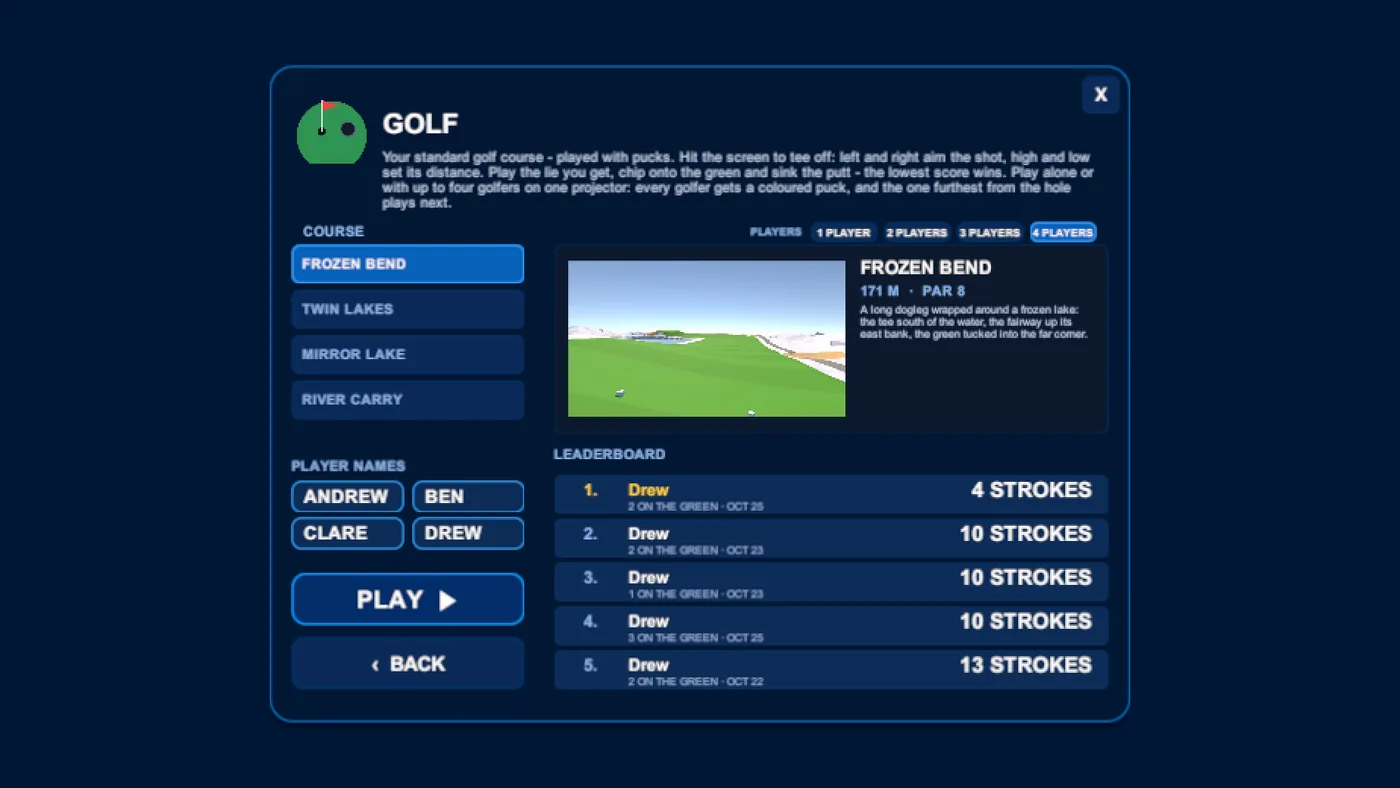
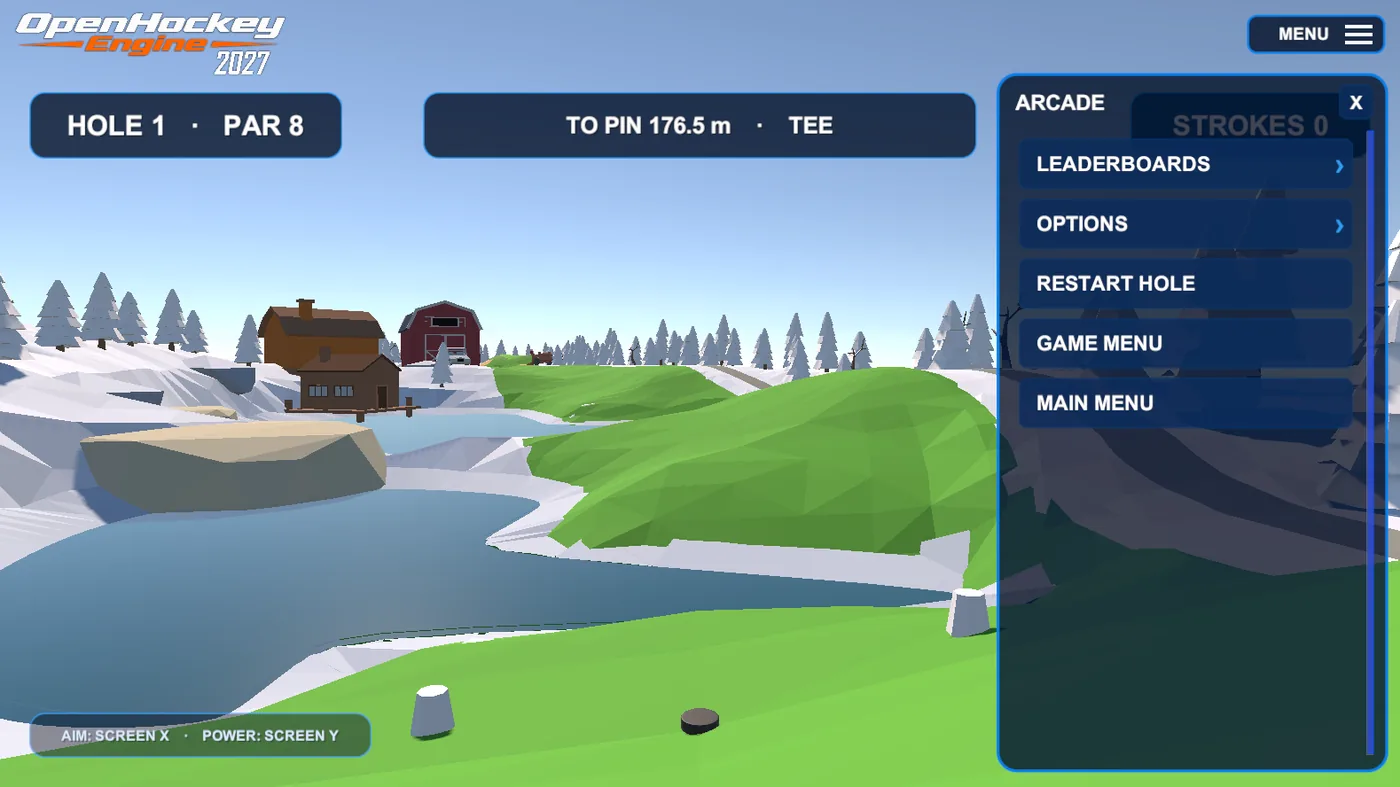
- Four modelled courses: Frozen Bend (a 171 m dogleg wrapped around a frozen lake), Twin Lakes (177 m with two lakes down the left), Mirror Lake (the 101 m island hole) and River Carry (a raised tee above a valley with a river to carry).
- One to four golfers on one projector: a coloured puck and a lie marker per golfer, a roster with every golfer's strokes and distance to the pin, and the furthest from the hole plays next - real away play.
- Screen X is direction, screen Y is distance - the middle of the screen plays about 27 m and the top is a 50 m range band.
- Play the lie you get: the rough halves your power, sand cuts it by three quarters, and a bunker shot kicks up sand.
- Water is a penalty stroke with the ball dropped where it was; the treeline is a hard boundary, so a lie is never lost.
- A shot that finishes within 2.5 m of the cup drops in; land on the green further out and you putt. Inside 12 m the aim assist bends toward the pin.
- The course card lists every course with its picture and facts, the PLAYERS switch for the roster (with a name per golfer), and that course's top-five leaderboard beside it.
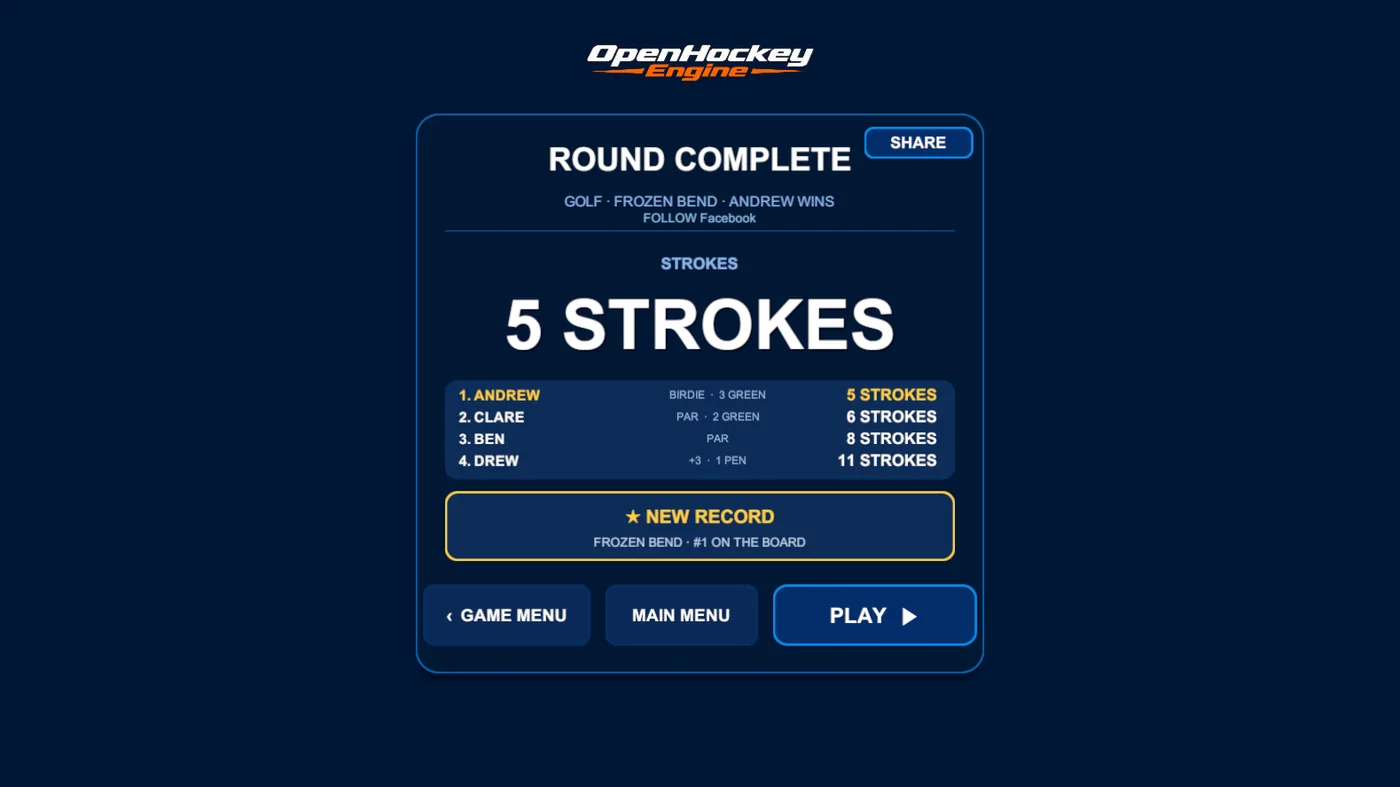
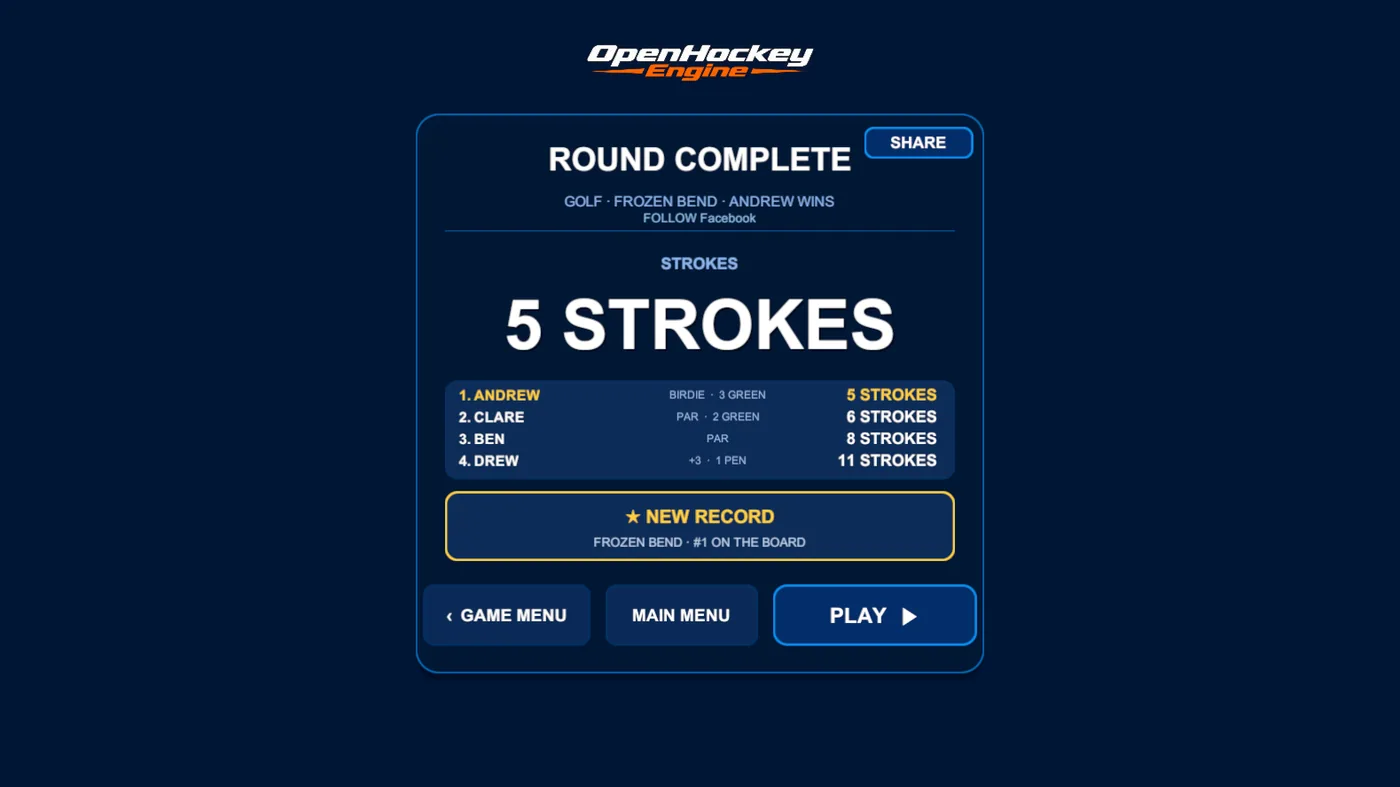
- Fewest strokes wins per course, with a birdie/par/bogey call, per-golfer standings on the results card, and every golfer's round submitted under their own name.
- Stuck with no shot out? RESTART HOLE in the side menu puts every puck back on its tee without leaving the round.
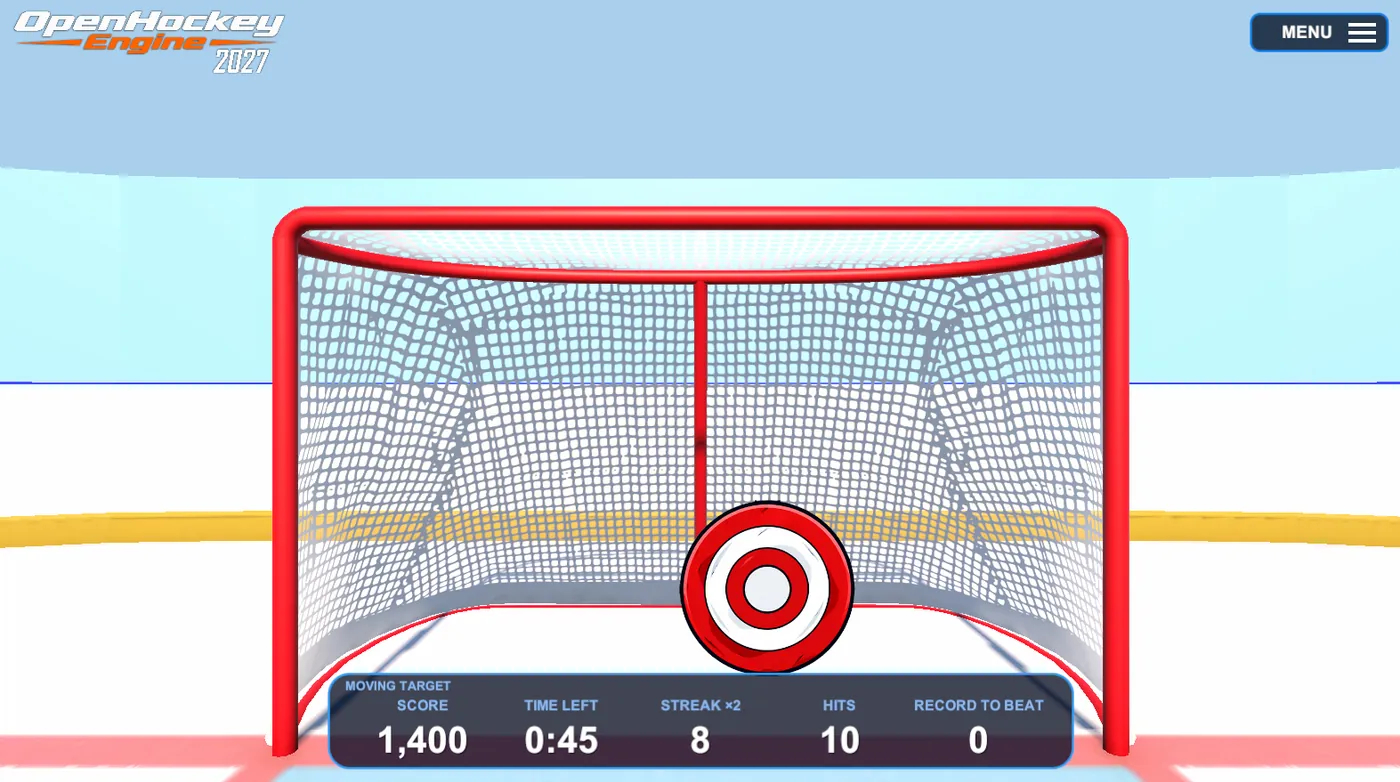
Moving Target
IncludedHit the target before it disappears.
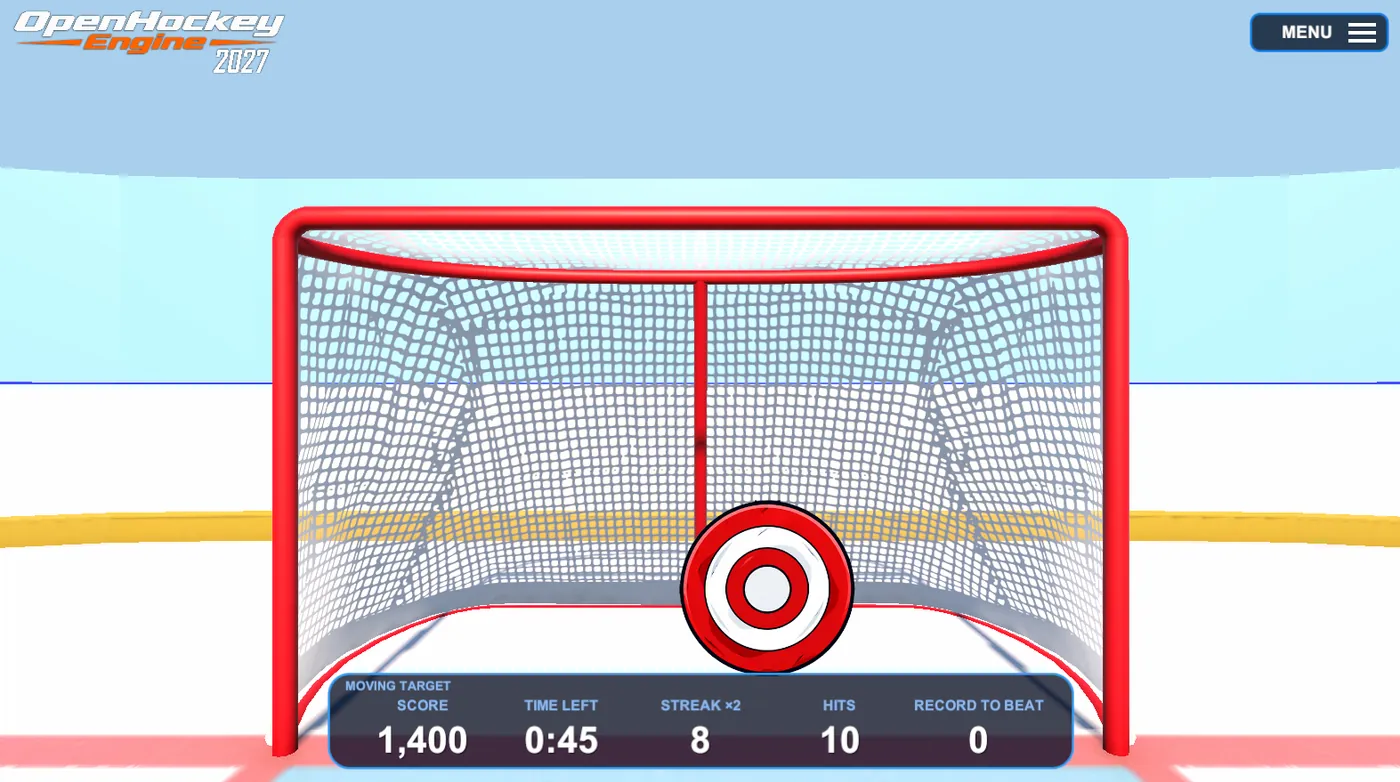
Bullseye targets appear in the net, hold for five seconds, then shrink away and pop up somewhere new - sometimes smaller, sometimes bigger. Hit as many as you can before the clock runs out.
- 30-second, 60-second, and 90-second rounds, plus an ENDLESS practice mode.
- Easy, medium, and hard change the mix of big, medium, and small targets.
- Consecutive hits build a score multiplier, up to x5; a live miss resets it.
- Targets shatter when struck, and counted hits flash the net green.
- A local top-five board for every timed mode and difficulty.
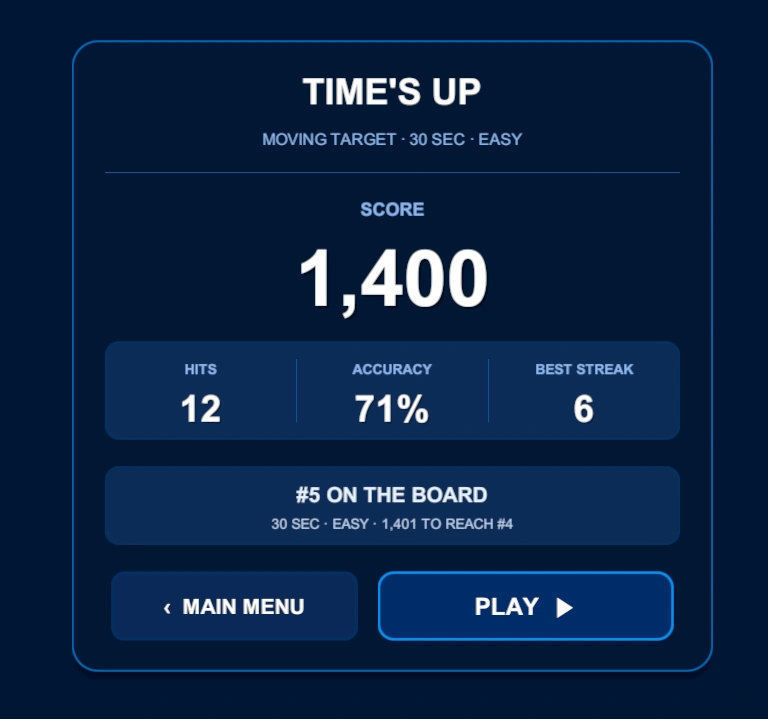
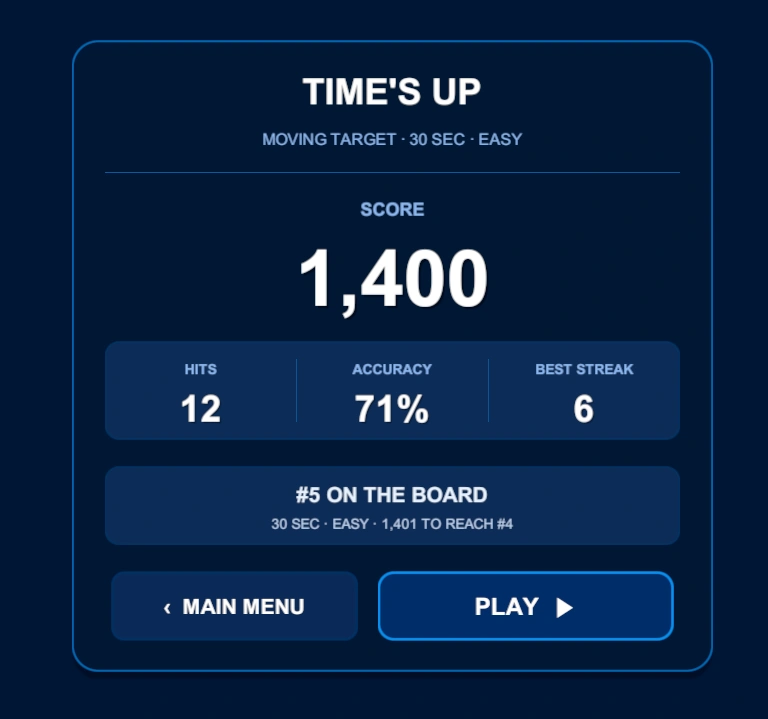
- Finish a run and see your rank, accuracy, best streak, and the score needed to climb.
Fastest Shot
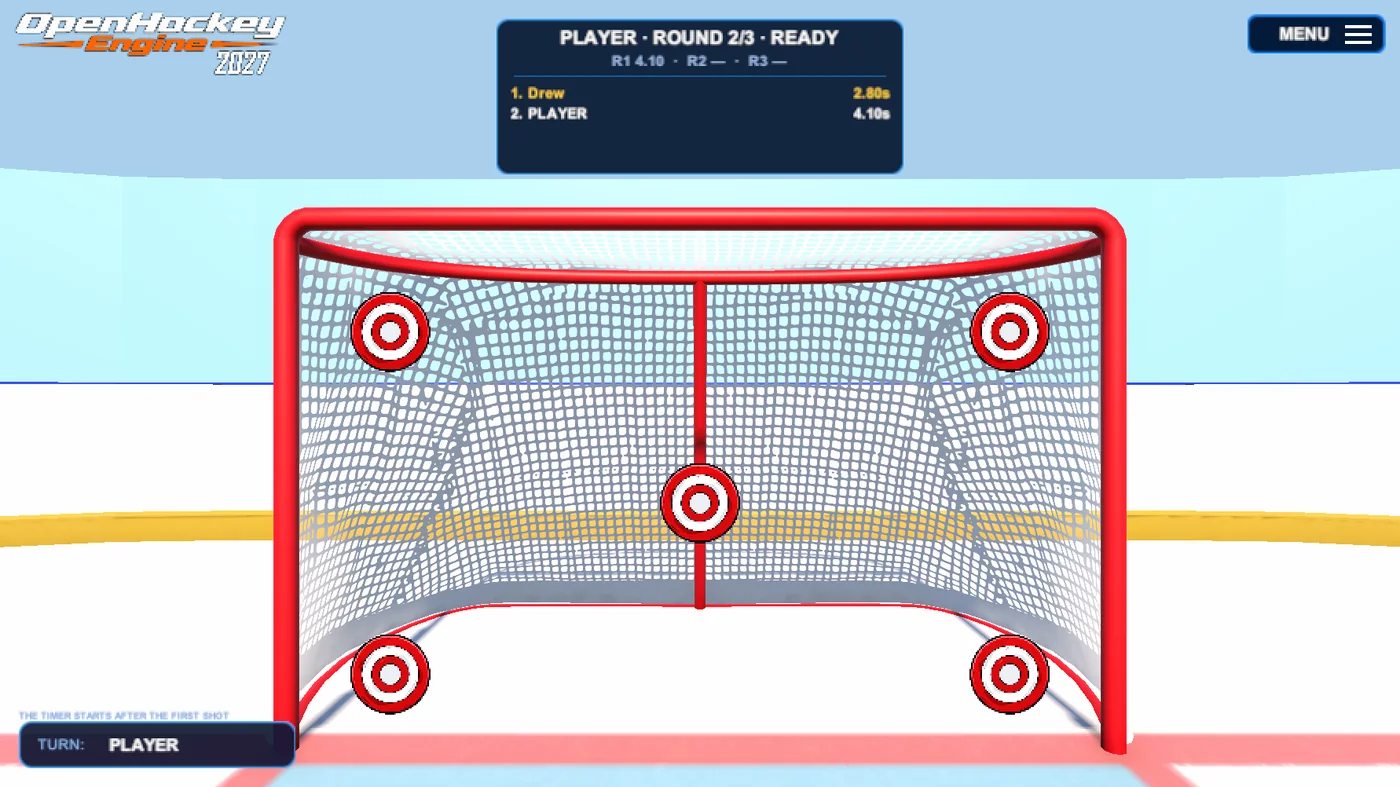
IncludedFive targets. One clock. Clear them all.
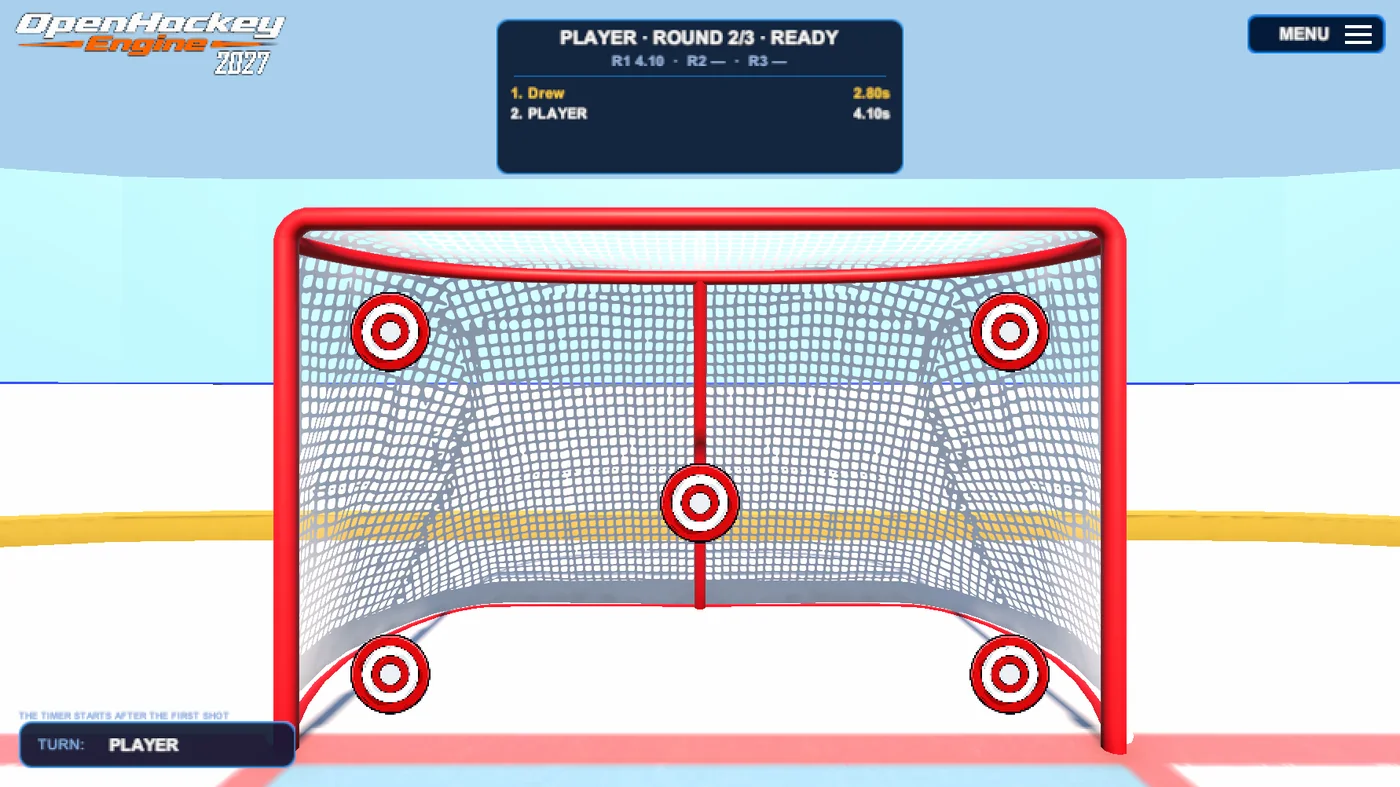
One target in each corner and one in the middle. Clear all five as fast as you can - the clock starts on your first shot. Play solo to set the record, or hot-seat with up to four players over three rounds each.
- 1-4 players, with one name field per player on the game card.
- Three rounds per player, sixty seconds a round, taking turns round-robin.
- The clock starts on the first shot - and that shot still counts.
- Round standings reorder after every turn; your best single round is what counts.
- A round that does not clear in time is a DNF, and DNF rounds carry no time.
- One local board per difficulty, credited to whoever set the fastest round.
- Full times, DNFs, and a final standings table on the results screen.
Cross 4
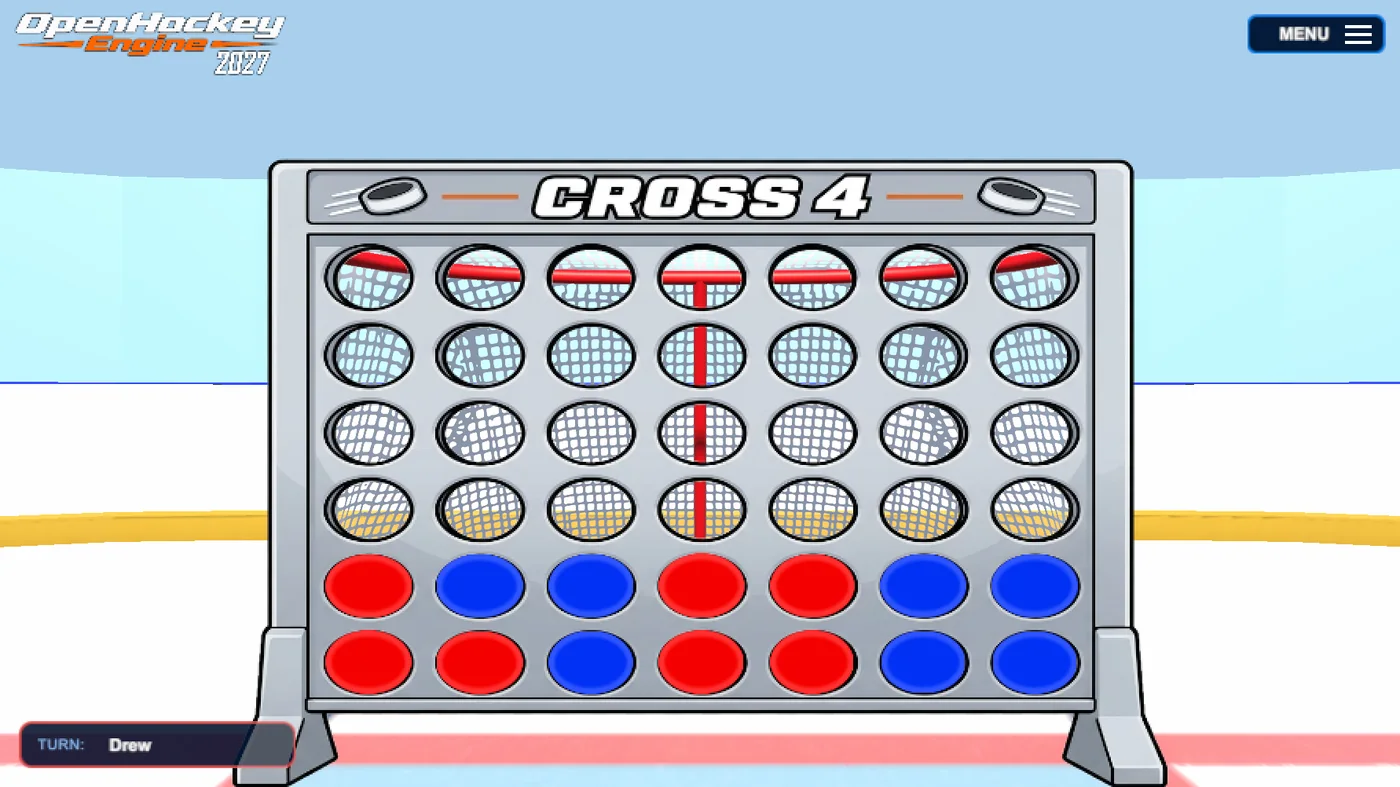
IncludedFour in a row, played with pucks.
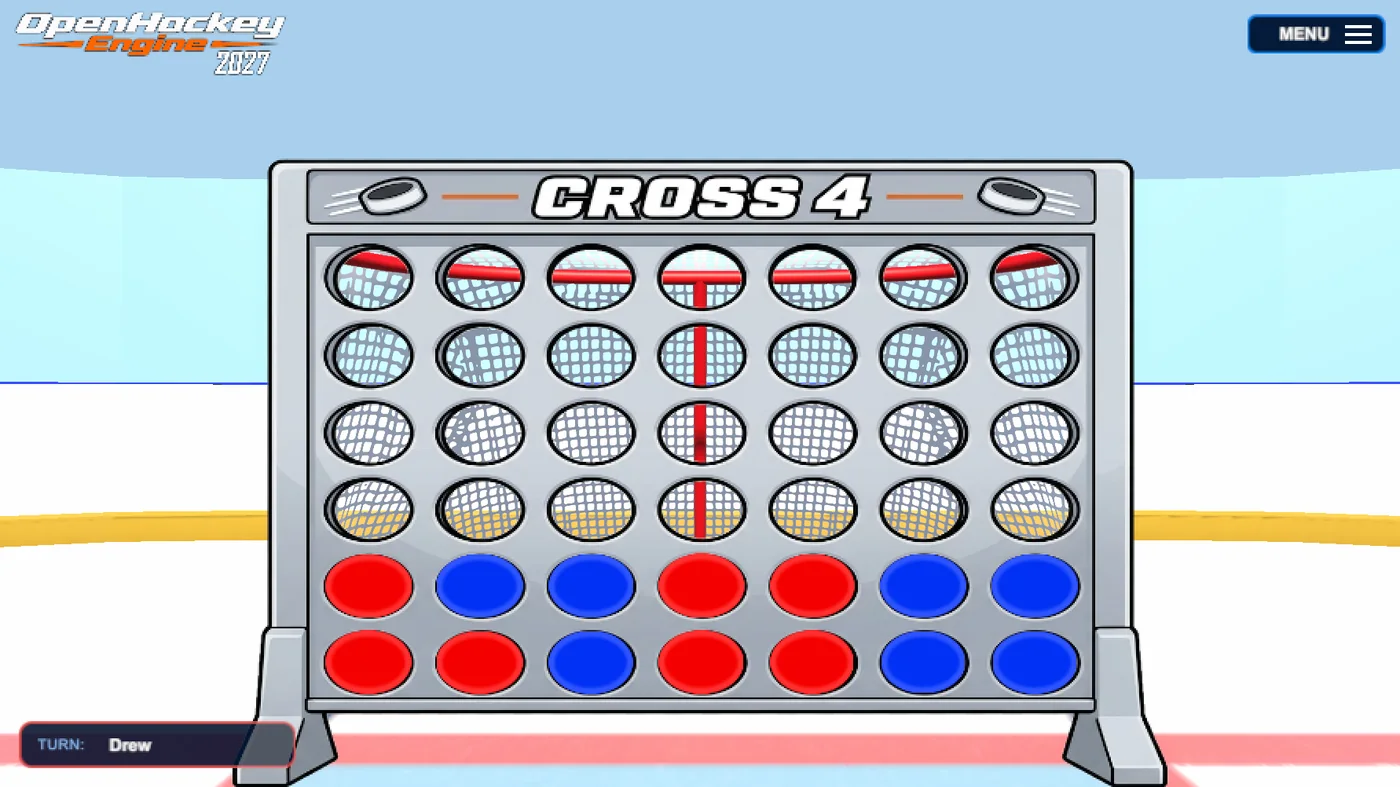
The classic four-in-a-row duel, played on the ice. Every shot plays the column it lands in and the disc drops into that column's lowest open slot. Line up four of your colour - across, down, or diagonally - before your opponent does.
- One player against the CPU, or two players hot-seat.
- Easy, medium, and hard AI: easy takes wins, medium wins and blocks, hard adds positional play.
- Your shot placement picks the column - no buttons, just the board.
- Four-in-a-row wins in any direction; a full board is a draw.
- No leaderboard by design - the match is its own reward.
- The winner's four discs get gold rings, and the results show each player's discs.
Bowling
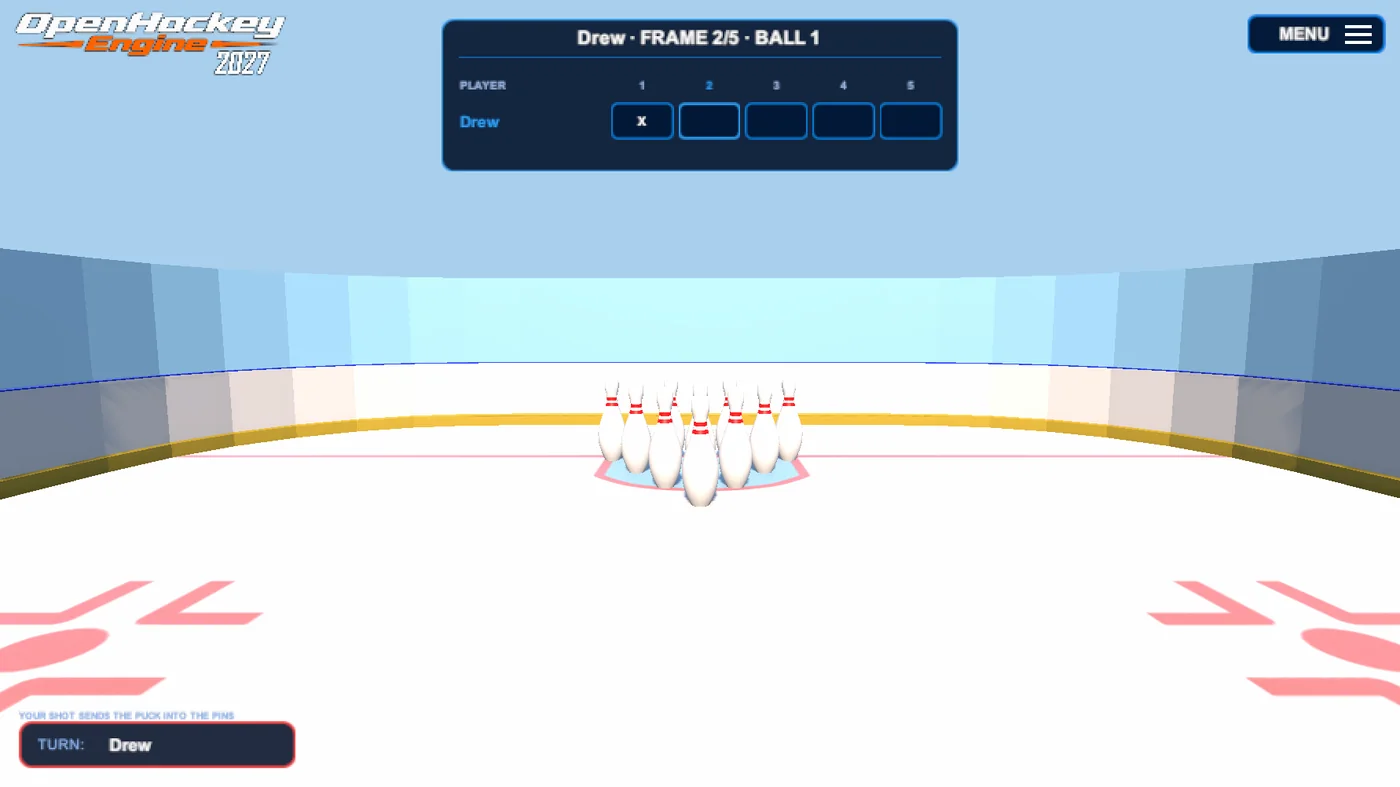
IncludedTen pins. One puck. No gutter talk.
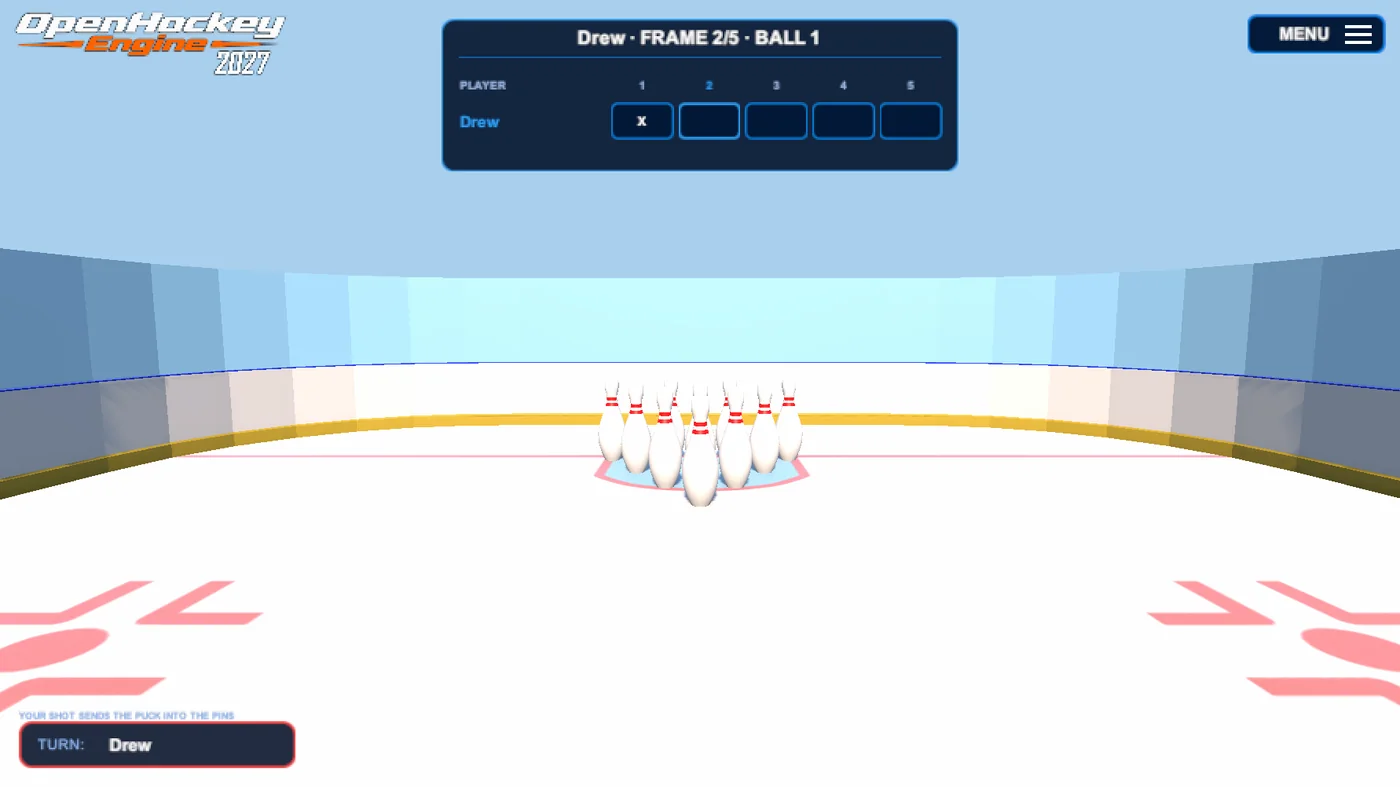
Your standard bowling alley, played with a puck instead of a ball. The pins are racked on the crease; your shot appears where it landed and flies into the rack. Strikes, spares, and the tenth frame's bonus balls all count.
- 1-4 bowlers, taking turns on one score sheet.
- Five frames for a quick game or ten for the real thing.
- Standard scoring with strikes, spares, and tenth-frame bonus balls.
- The pin action is a real impulse simulation - the rack falls the way the shot hit it.
- Aim with your shot: center goes straight, off-center shots angle out toward the pins.
- Local boards for 5-frame and 10-frame games, credited to every bowler's own name.
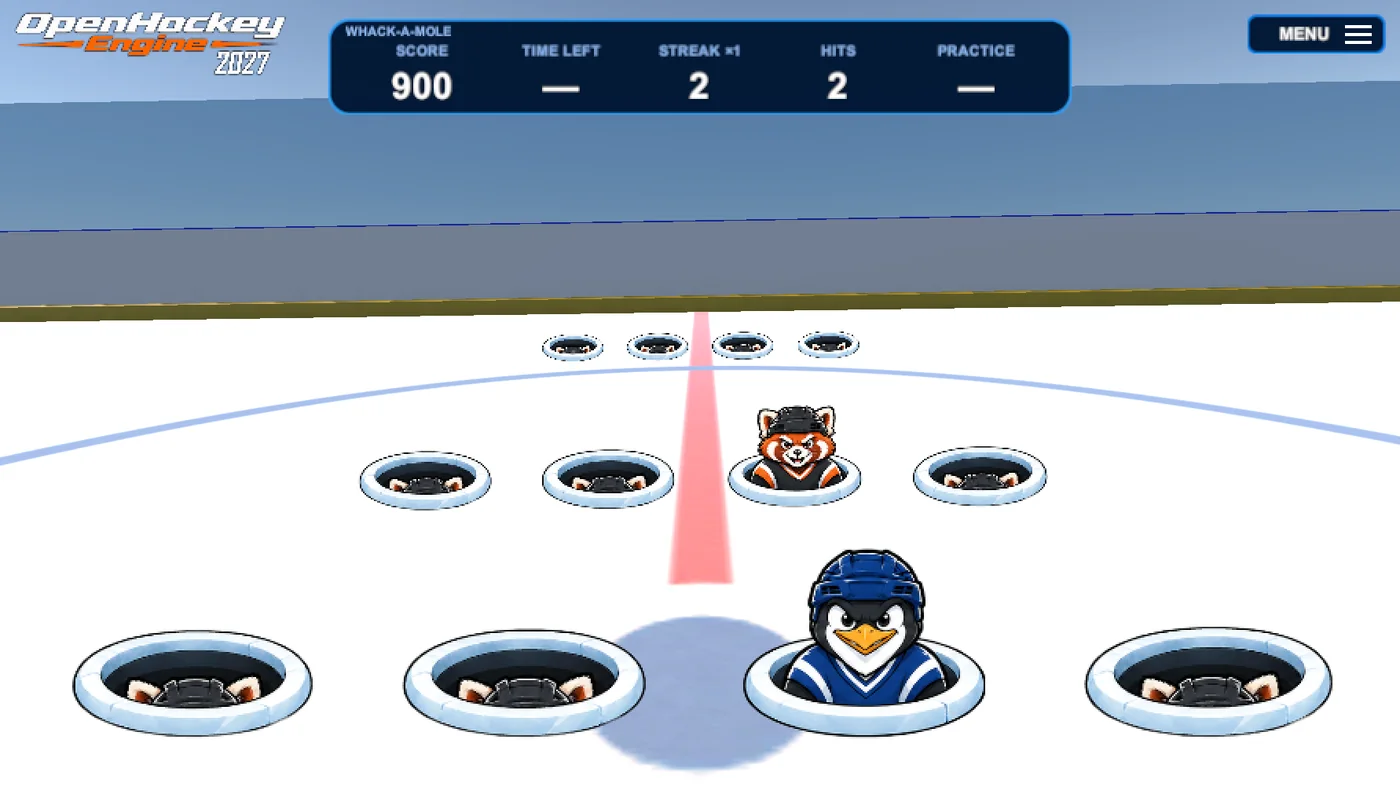
Whack-a-Mole
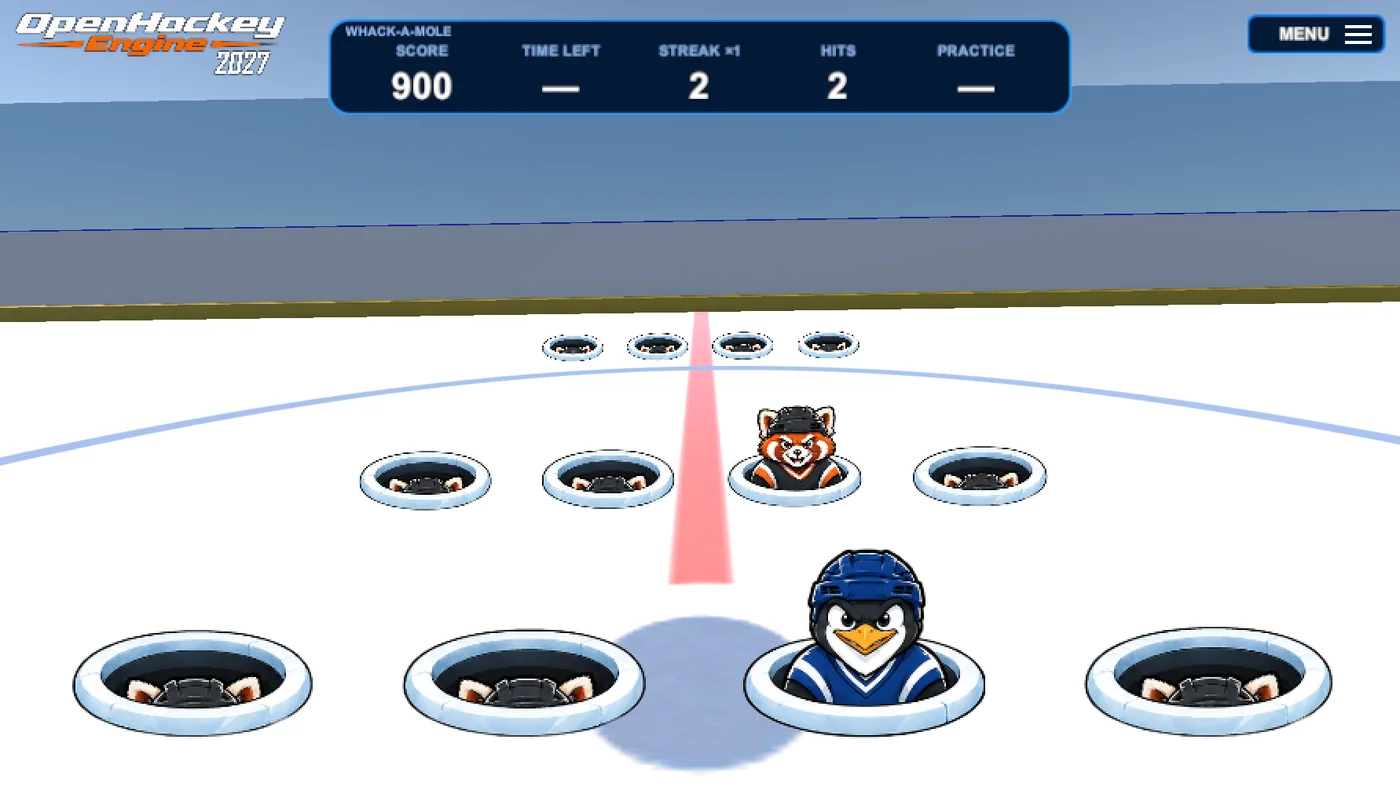
IncludedTwelve holes. Three mascots. One quick puck.
Red pandas, cats, and penguins pop out of twelve holes across the ice. The nearer the hole, the safer the shot; the farther back the row, the more it pays. Stack consecutive hits for a streak multiplier and clear the board before the clock runs out.
- 30-second, 60-second, and 90-second rounds, plus ENDLESS practice.
- Easy, medium, and hard change how many mascots pop and how long they stay up.
- Red panda 100 points, cat 150, penguin 250 - the bigger prize holds for less time.
- Row value multiplies the score: near x1, middle x2, far x3.
- Consecutive hits add the shared streak multiplier, up to x5.
- A shot into an empty hole is a miss and resets the streak; a shot outside every hole is ignored.
- Local boards for every timed mode and difficulty.
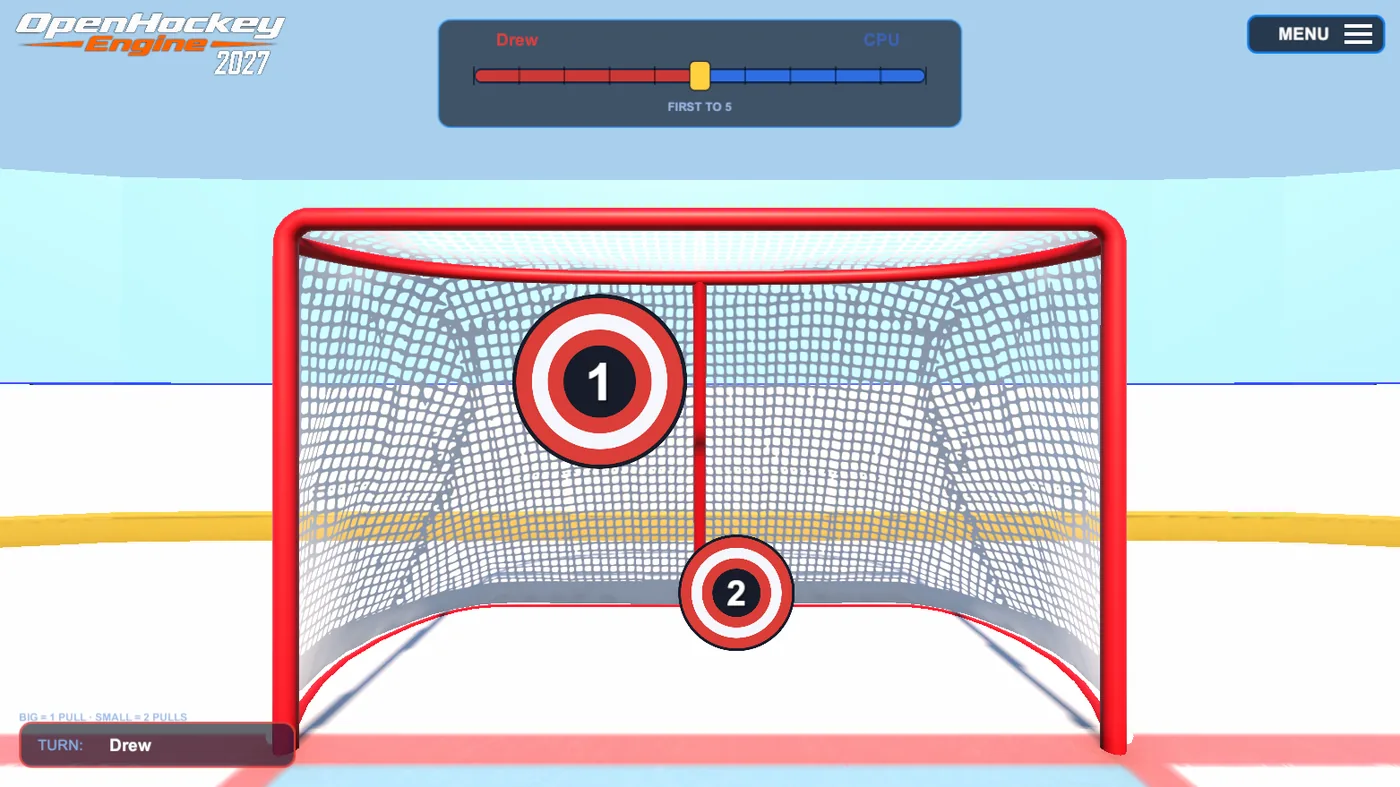
Tug of War
IncludedTwo targets. One rope. Pull the line your way.
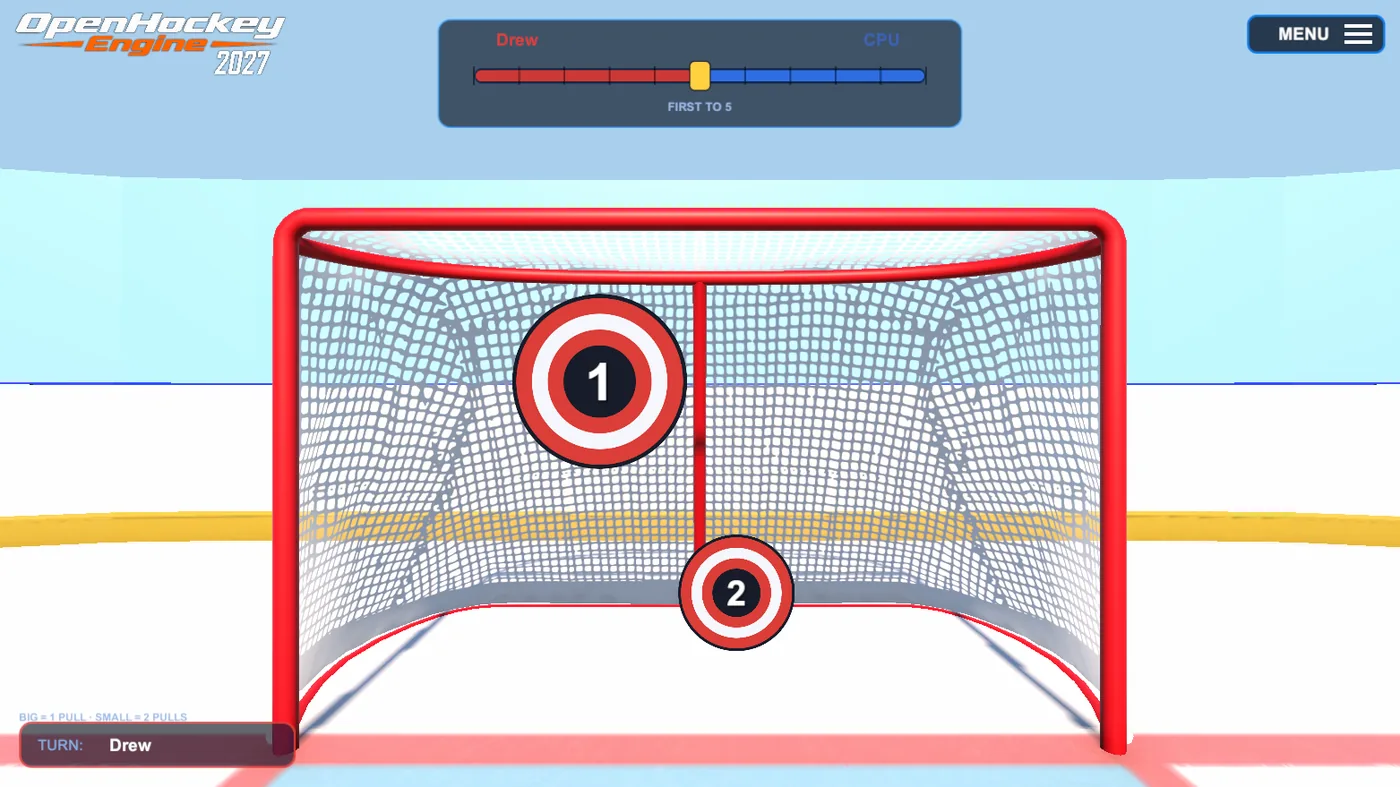
Every turn grows two targets in the shooter's colour: a big one that is easy to hit and pulls the rope one notch, and a small one that pulls two but is easy to miss. Hit yours to drag the line toward your side - first to the score wins.
- One player against the CPU, or two players hot-seat - red versus blue.
- Two targets a turn: the big one pulls 1, the small one pulls 2.
- Easy, medium, and hard change the target sizes, never the pull values.
- Match length of 3, 5, or 7 pulls on the game card.
- A miss only wastes the turn - nothing is ever taken away.
- CPU skill slider (1-100%) sets exactly how often the CPU lands its shot.
- No leaderboard by design - the match is its own reward.
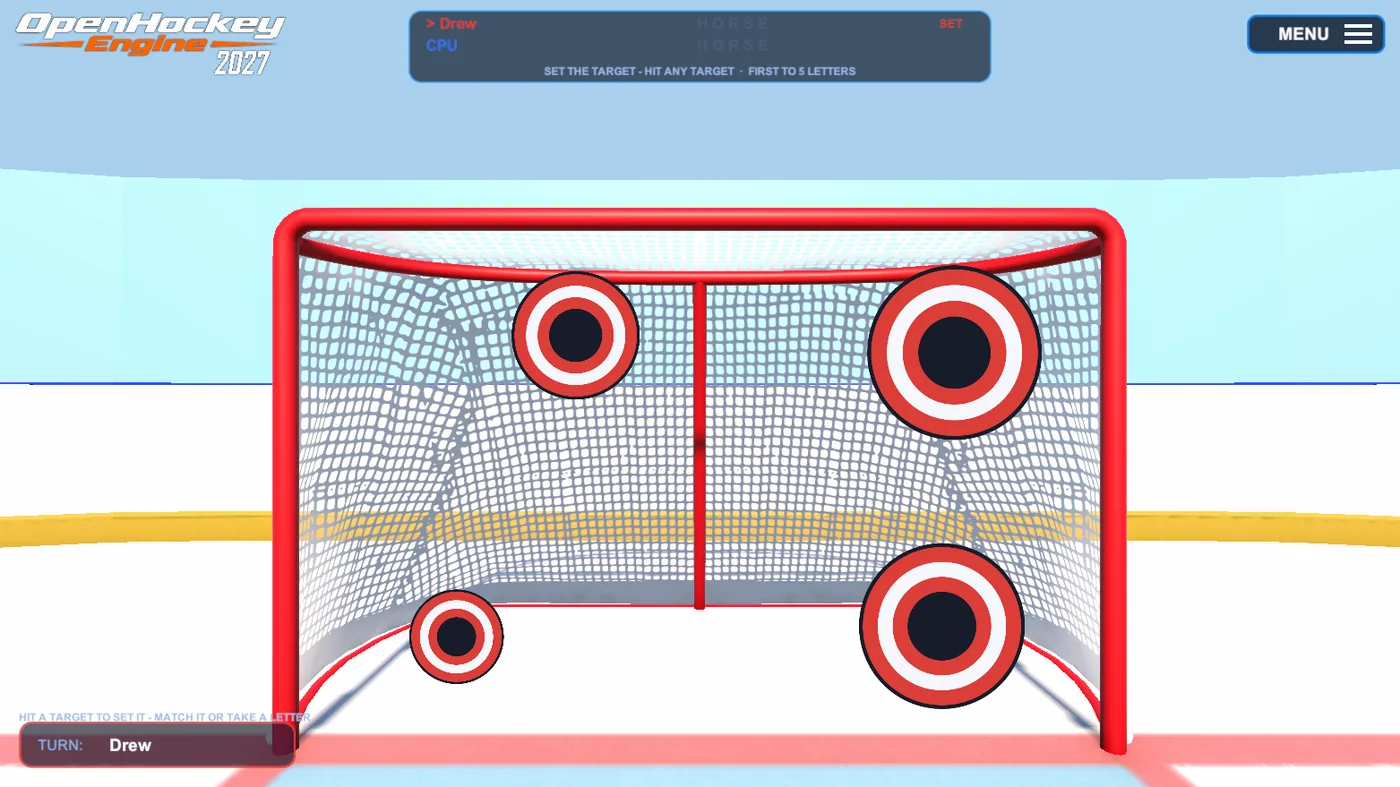
Horse
IncludedSet the target. Everyone else has to match it.
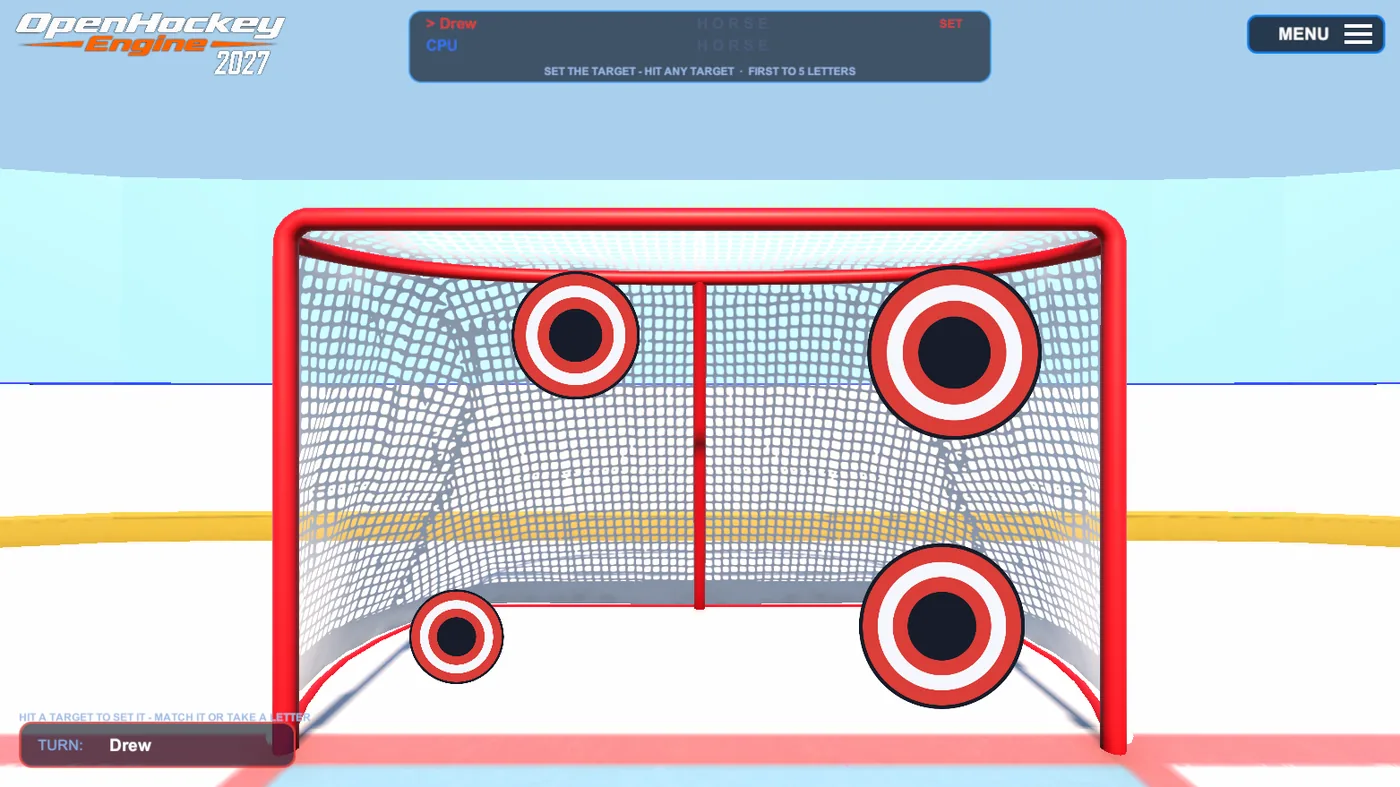
The classic H-O-R-S-E game, played on hockey targets. Every round deals three or four targets; hit one to lock it in gold, and every other player must hit that same target or take a letter. Five letters and you are out.
- 1-4 players, taking turns on one projector - solo plays against the CPU.
- Three or four targets a round, always including one big and one tiny.
- Set the target: a hit locks it with a gold halo and clears the rest.
- Every other player must match the locked target or take the next letter of H-O-R-S-E.
- A setter's miss costs only the turn - five letters eliminate, last player standing wins.
- Easy, medium, and hard change the target sizes; the CPU skill slider sets its accuracy.
- No leaderboard by design - the match is its own reward.
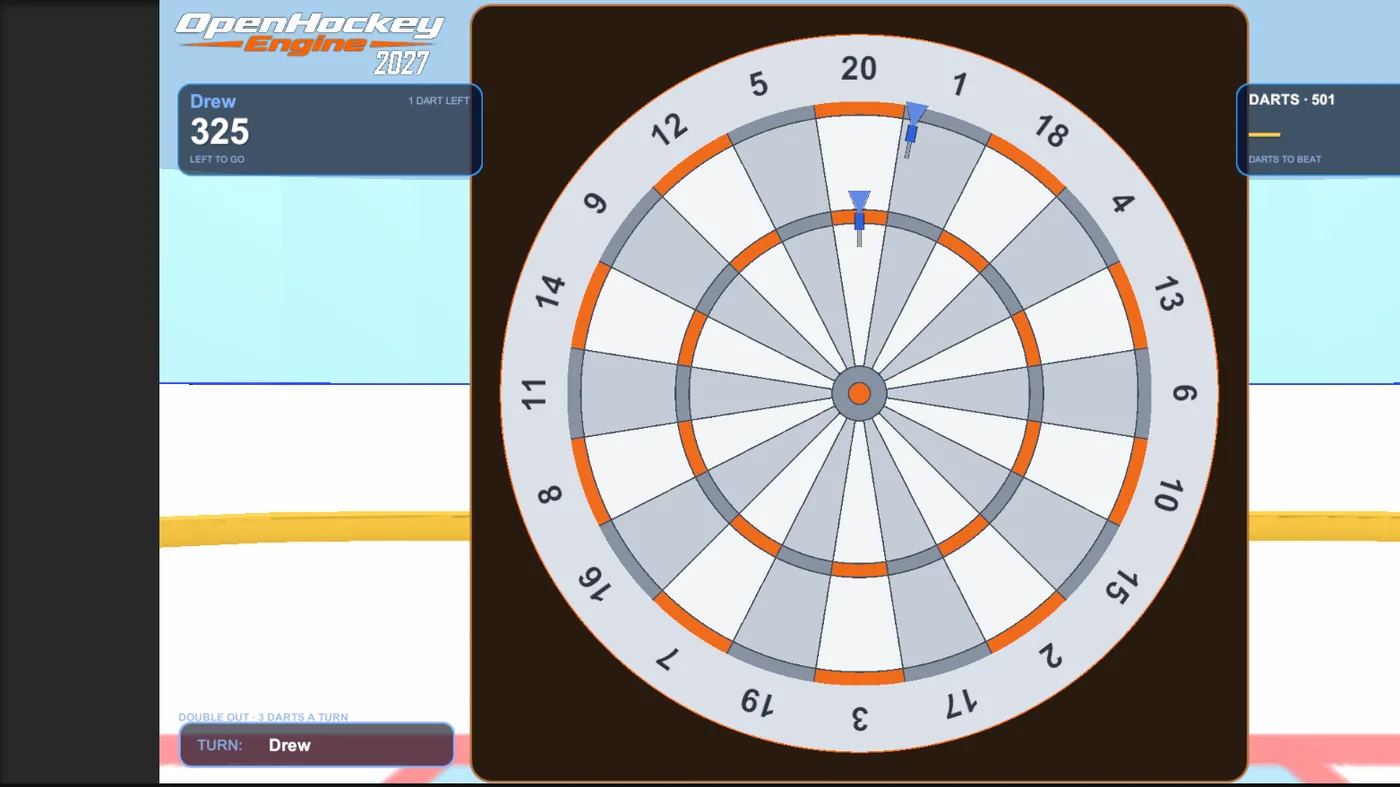
Darts
IncludedWherever your shot lands is where your dart lands.
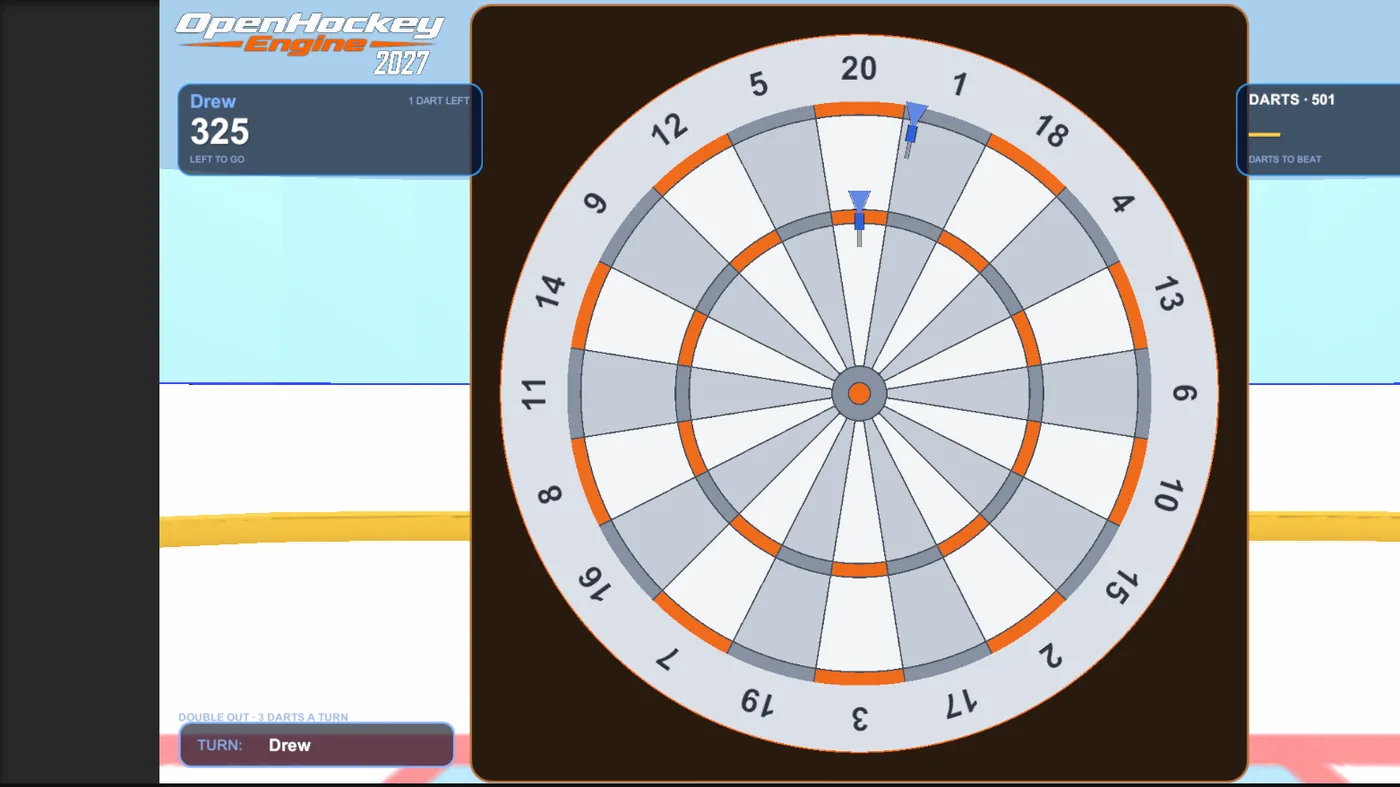
A dartboard hangs on the wall and your shot becomes the dart. Play 501 or 301, where the first dart to land exactly on zero wins, close out Cricket, or run 1 to 20 and the bull in Around the Clock - solo for a fewest-darts run, or two players hot-seat.
- Four games: 501, 301, Cricket, and Around the Clock.
- 501 and 301 are straight out - the first dart to land exactly on zero wins the leg, and a dart that goes past zero or leaves 1 busts the turn.
- Trebles, doubles and the bull all score their real value on the way down.
- Cricket closes 20-15 and the bull; Around the Clock runs 1 to 20 and finishes on the bull.
- Three darts a turn, 1-2 players hot-seat.
- Solo runs keep a fewest-darts board per variant; two-player matches are unscored.
- Hits are exact - no goal-credit slop on a precision game.
Learn to find the opening on a variety of goalies.
In Free Shoot you can select from a variety of goalie poses and options. Practice finding the openings and apply it to your game. Check out some of the goalie options below:
Features to get the most out of your sessions
Use the coaching timer to timebox a session, or run the Lifting the Puck drill - the green band climbs one slice of the net for every hit until it reaches the crossbar. The Shooter Tutor turns the net into a set of aim points. Every session keeps its own goals, misses, saves, and shot markers.
Buy Now $30Local leaderboards to face off against friends and family.
Each scored arcade game keeps its own top-five boards - per mode and difficulty where they matter. Finish a run and see exactly where you landed: your rank, your accuracy, your best streak, and the score standing between you and the next spot up.
Let's make training fun.
Purchase the 2027 Edition of OpenHockey Engine and start training right at home!
Buy Now $30- Full access to the game. No subscriptions. No in-game purchases.
- Free Shoot: dial in your accuracy, learn the openings on each goalie, and take those skills to the ice.
- Nine arcade games: Golf, Moving Target, Fastest Shot, Cross 4, Bowling, Whack-a-Mole, Tug of War, Horse, and Darts.
- Golf with four modelled courses - Frozen Bend, Twin Lakes, Mirror Lake, and River Carry - one to four golfers on one projector, and a strokes board for each course.
- Local leaderboards for every game where a score applies - with player names, records to beat, and a shareable result card.
- All updates to the 2027 Edition of OpenHockey Engine.
Set up your simulator right at home.
4 steps between in and your first shot.
Install it
Use the installer to install and keep your game up to date. On first install, provide your key, which should have arrived via email or can be found by signing in on this website with the E-mail address used to purchase.
Set up your projector
Project your game screen onto a white projector screen or tarp.
Plug in the camera
A USB webcam. Open Camera Configuration and the game shows you a live preview of exactly what the camera sees. Mount it behind or beside you, aimed at your impact screen.
Calibrate the camera
The game turns the wall white, measures the projected area, and asks you to fit a box around it on a snapshot. That fit is saved and reused, so setup is one-time. A black puck on a bright projection gives the most accurate shot placement.
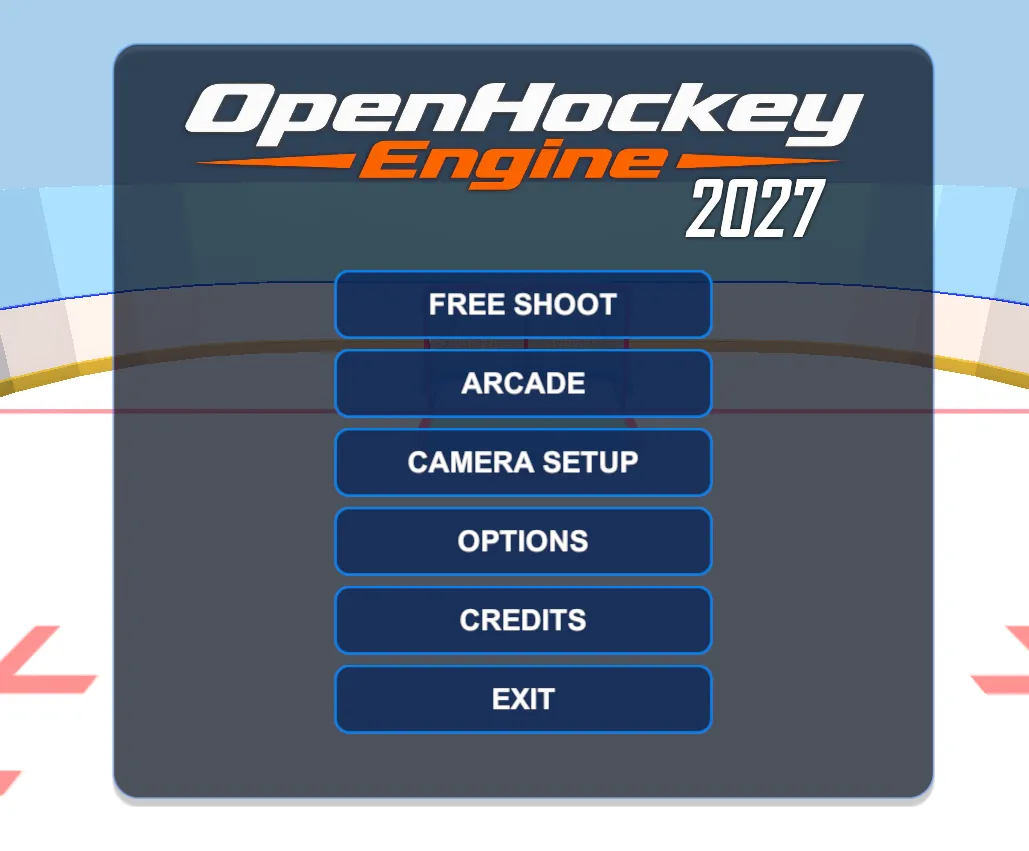
Straight from the game.
Runs on hardware you already own.
OpenHockey Engine is built for consumer hardware. You do not need a commercial sim rig, a launch monitor, or a gaming PC. If your computer plays modern games at 1080p, it runs OpenHockey Engine.
Computer
Built to run on consumer hardware right at home. No need for a full launch-monitor simulator.
| Component | Minimum | Recommended |
|---|---|---|
| Operating system | Windows 10 (64-bit) | Windows 11 (64-bit) |
| Processor | Intel Core i3-10100F / AMD Ryzen 3 2600 | Intel Core i5-11500K / AMD Ryzen 5 3600 |
| Memory | 8 GB RAM | 16 GB RAM |
| Graphics | NVIDIA GTX 1650 / AMD Radeon RX 580 | NVIDIA RTX 3060 / AMD Radeon RX 6700 |
| Storage | 8 GB | 8 GB |
- An SSD is strongly recommended over a hard drive for load times.
- Hardware from 2019 or newer is recommended for Unity 6.
- DirectX 11 or DirectX 12 required.
- Android and iOS builds use the same camera pipeline with the device camera; the Windows installer is the supported home setup.
Minimum and recommended PC specs based on Unity 6 requirements. It is recommended you play on hardware that is 7 years or newer.
Camera
A USB webcam. No depth camera, no special hardware, no calibration rig. OpenHockey Engine watches a flat surface for the moment a puck makes contact and maps that impact back onto the projected image.
| Type | A USB webcam - 720p or better | |
|---|---|---|
| Frame rate | 30+ fps (Windows processes at 1280x720; target FPS 30, 15-60 available); 60 fps tracks hard shots best | |
| Exposure | Auto-exposure is on by default - it exposes for the bright projection, so the puck reads dark | |
| Budget | A $25-60 1080p webcam is generally fine | |
- Mount it beside the net with the whole net in view, aimed at the impact screen - not behind the shooter.
- The in-game camera preview shows exactly what the game sees, so you can fine-tune placement yourself.
- On Android and iOS the device camera replaces the USB webcam.
Projector
A standard projector is required to use the simulator. Consider at least 3,000 lumens. A better projector will increase the accuracy of the simulator and make it easier for the camera to track impact.
A hockey shot travels faster and flatter than a golf ball. Mount your projector behind or above your shooting lane — never in it.
| Throw ratio | Standard Project behind, mounted above, or to the side. Or a Short-throw projector closer to the screen, but out of the shooting area. | |
|---|---|---|
| Brightness | 2,500–3,000 lumens for a dim room · 3,000–4,000 with windows or ambient light | |
| Resolution | 1080p is plenty — 4K optional | |
| Latency | Low input lag, so the impact registers when it happens | |
- Budget: BenQ TH671ST — 1080p, 3,000 lumens, the long-time sim-community favourite.
- Best value: Optoma GT2100HDR — laser, 4,200 lumens, 0.496:1 throw.
- 4K: BenQ TK710STi — 4K, 3,000 lumens.
Example consumer projectors and approximate street prices, September 2026. No affiliate links.
Room and space
How much room you need to set up your shooting area.
| Projection area | 8 feet wide projection recommended | |
|---|---|---|
| Shooting distance | Shoot from at least 10 to 20 feet back | |
| Surface | Contact rated projection screen, tarp, or 10 mil polyethylene plastic. | |
- Light can impact your projection quality. A dimmer room or simulation enclosure can improve game quality.
Questions before you buy
What do I need to play?
A Windows 10 or 11 PC, a projector, a USB webcam, and a shooting surface. That is the whole list. If your computer plays modern games at 1080p, it runs OpenHockey Engine. Check the minimum specs above.
Do I need to buy a projector or camera?
Only if you do not already have one. A $25 webcam and a budget projector are enough to start; better hardware just means a brighter, larger, sharper rink. A 60 fps webcam tracks hard shots best.
Does it need to be online?
Only to activate your key the first time and to check for updates. After activation, play offline; the game will simply skip its update check when it cannot reach the server.
How do the editions work?
OpenHockey Engine is a yearly release. Each edition brings new modes, features, and improvements over the last years. The goal is instead of a live service game requiring a subscription or in-app purchases, your purchase is good for as long as you want to play it. Bought the 2027 Edition? Play it for 3 years or buy the new version each year.
Can I try it before buying?
Buy now is the fastest route in - the purchase page takes you straight to checkout. Eventually I plan to get a limited free version of the game out so you can test your hardware before making the purchase.
Which modes are included?
Free Shoot plus nine arcade games: Golf, Moving Target, Fastest Shot, Cross 4, Bowling, Whack-a-Mole, Tug of War, Horse, and Darts. Golf ships with four modelled courses, one to four golfers per round (each with a coloured puck and their own score card), and a strokes leaderboard for each course. There are no in-game purchases or add-ons.
Can I play with someone else?
Yes. Golf, Fastest Shot, Bowling, and Horse take 1-4 players, and Cross 4, Tug of War, and Darts take 1-2. Hot-seat against a friend on the same projector, or play solo against the CPU in Cross 4, Tug of War, and Horse. Golf's four-golfer round is a real stroke-play card: the golfer furthest from the hole plays next. Moving Target and Whack-a-Mole are solo score chases.
Are the leaderboards online?
No - they are local to your PC and need no account or internet. Each scored arcade game keeps its own top-five board with a player name on every run, and the results screen shows the score or time needed to climb.
Turn your home into your own training facility.
Plug in a projector, point a webcam at the screen, and take your first shot tonight.
Buy Now $30